


It started, like most things, on my For You page.
A girl I’d never heard of explained that if I ate seeds at the right time of month, exercised according to my hormonal phase, and structured my whole life around a four-phase framework, I would feel completely different. More energy. Less PMS. Better skin. Clearer thinking. Hormonal balance. I scrolled through the comments — thousands of women saying it changed their lives, asking how to start, tagging friends to try it with them.
And I thought: okay, but what actually is this?
So I did what I always do. I went looking for the research.
What I found was not a simple story. It was not “cycle syncing is a scam,” that’s the hot take making the rounds in the medical community, and it’s not the full picture. But it was also not “this programme will transform your hormones,” which is what the wellness industry is selling with aggressive confidence.
The actual answer is considerably more interesting than either of those.
#cyclesyncing has amassed tens of millions of views. A 2025 study published in Perspectives on Sexual and Reproductive Health analysed 100 cycle syncing TikTok videos and found that only 30% of creators provided any credentials, and a remarkable 4% cited scientific sources. Four percent. The content is viral, the messaging is confident, and almost none of it is connected to research in any verifiable way.
Meanwhile, the scientific literature on whether exercise or diet should be structured around the menstrual cycle is genuinely contested. The Strength and Conditioning Journal published a 2025 critical review concluding that “research does not support the idea that periodizing or programming strength or endurance training according to the menstrual cycle confers additional benefits over more traditional approaches.” A different 2020 meta-analysis found exercise performance is trivially reduced in the early follicular phase — just not enough to build a training programme around.
Both are true. The nuance between them is where cycle syncing either becomes genuinely useful or becomes another wellness framework that makes you feel guilty for not doing it right.
Here’s what I want to do: give you the evidence-based version of cycle syncing. The part where the biology is real and the practical applications make sense. The part where the wellness industry has overreached. And the most important part — which nobody in the TikTok ecosystem is explaining, which is the why behind the recommendations, because once you understand the biology you can make your own decisions rather than following a programme someone invented in 2014.
PS: We also have a subscriber-only group chat where members discuss the deep dives, share their sleep journeys, and ask me questions directly. See you there.
Disclaimer: The information and opinions expressed above are current as of the date of this post and are subject to change without notice. Materials referenced above are provided for educational and informational purposes only. None of the above constitutes medical advice, a diagnosis, a treatment recommendation, or a substitute for consultation with a qualified healthcare professional. Always seek the guidance of your doctor or another qualified health provider with any questions you may have regarding a medical condition or sleep disorder.
Short Dive below ↓
Table of Contents:
Hormones and How They Actually Change Your Body Across the Month
What The Research Actually Supports For Nutrition
Cycle Awareness vs. Cycle Syncing — The More Useful Framing
The Evidence-Backed Nutrition Guide for Each Phase
The Workout Framework That Evidence Actually Supports
Cycle Awareness in Practice — How to Track and What to Do With It
The Phase Guide — Everything in One Place
The Point Is Awareness, Not Optimisation
Chapter 1: What Cycle Syncing Actually Is And Where It Came From
The Origin Story
Cycle syncing as a named practice was introduced by functional nutritionist Alisa Vitti in her 2014 book WomanCode. The core idea: the four phases of the menstrual cycle; menstrual, follicular, ovulatory, and luteal, create four distinct hormonal environments, and aligning your diet, exercise, and lifestyle with those environments will optimise how you feel across the month.
This is, broadly, a reasonable premise. The hormones are real. The four phases are real. The idea that different hormonal environments might require different inputs is biologically plausible. The problem is that the leap from “hormones change across the cycle” to “here is the exact programme you should follow” was made without the clinical trials that would justify it.
Cleveland Clinic’s Dr. Albers notes that the cycle syncing programme “hasn’t been researched in a clinical setting,” meaning there are no randomised controlled trials testing whether following a cycle-synced diet and exercise plan produces better outcomes than a standard healthy diet and exercise plan. What exists are studies on hormonal fluctuations and their biological effects. Cycle syncing takes those studies and builds a lifestyle programme on top of them. Whether that specific programme works is the untested part.
This is not unusual in wellness. Most of the practical advice that turns out to be useful was plausible before it was proven. The question is how to use the genuine biology without buying wholesale into the unprovable programme.
The Four Phases — The Real Biology
The four phases of your cycle aren’t a wellness invention. They’re real biology. Here’s what each one actually looks like — no jargon, just what’s going on.
Menstruation (Days 1–5) Both estrogen and progesterone are at their lowest. They dropped off at the end of last month’s cycle, and that drop is what triggered your period. Hormonally, this is the quietest and most depleted point of the whole month.
Follicular Phase (Days 6–13) Your period ends, and estrogen starts climbing. Progesterone stays low. There’s one hormone doing one thing, in one direction. No conflict, no competing effects. This is why most women feel noticeably better in this stretch, their hormonal environment is simple and rising.
Ovulation (Days 13–15) Estrogen hits its peak, which triggers the release of an egg. This window is short, usually 24 to 48 hours. After ovulation, progesterone starts to rise and takes over as the dominant hormone for the rest of the cycle.
Luteal Phase (Days 16–28) Progesterone is in charge now. Your body temperature goes up slightly. If pregnancy doesn’t happen, both hormones drop off toward the end of this phase and that drop is what kicks off the next period, starting the whole thing again.
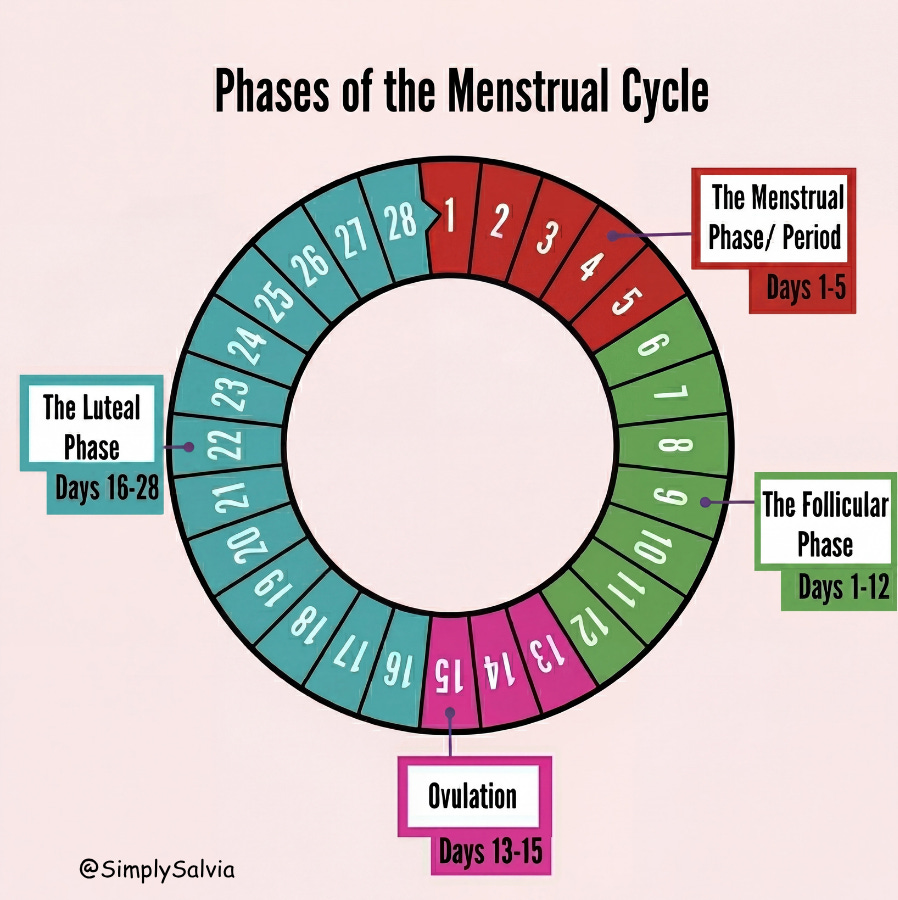
One thing the TikTok version almost never mentions: this neat 28-day cycle with ovulation on day 14 is a textbook average, not a guarantee. Real cycles can be anywhere from 21 to 35 days. Ovulation timing shifts. Some cycles don’t produce an ovulation at all. And if you have PCOS, irregular periods, or you’re on hormonal contraception, your hormonal pattern may look completely different from this template.
This matters because most cycle syncing content is built around the idealised 28-day version. If your cycle doesn’t match that — which many women’s don’t. The day-specific prescriptions (”do HIIT on day 12, eat seeds on day 18”) may not apply to you at all. That’s the first reason to hold the specific programme loosely.
So Why Do So Many People Swear By It?
Because the underlying biology is real, even if the programme built on top of it isn’t fully proven.
Hormones genuinely affect your body in ways that are documented in research. Progesterone raises your body temperature and disrupts deep sleep in the second half of your cycle. Estrogen supports serotonin, which is why your mood tends to be more stable when estrogen is rising. In the week before your period, both hormones drop off quickly, and that drop removes two of your nervous system’s natural calming effects at once. Your body actually burns more calories at rest in the luteal phase; somewhere between 100 and 500 extra per day which is why you’re genuinely hungrier, not just emotionally reaching for food.
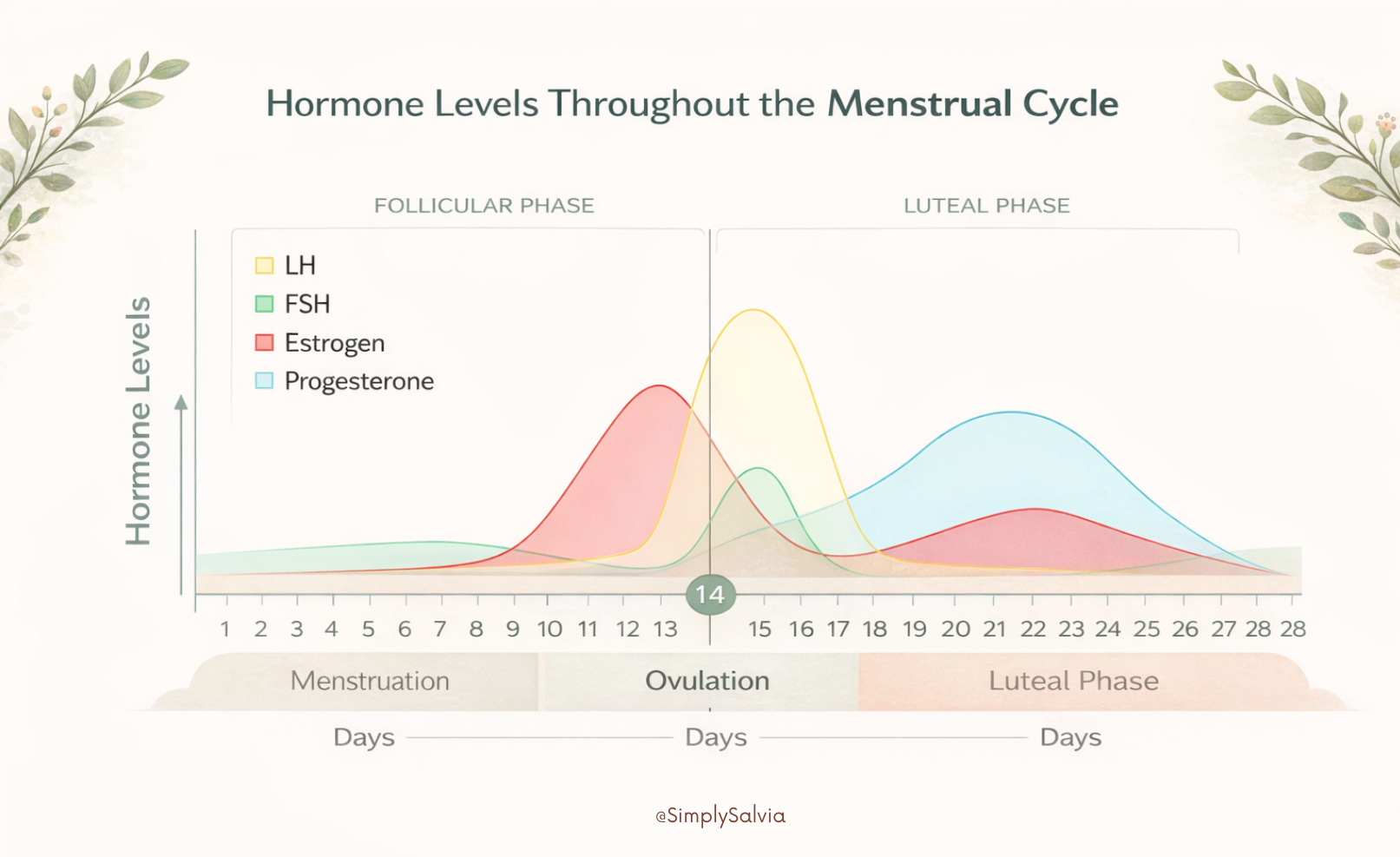
These things are real. Women who say their energy, mood, sleep, and capacity feel completely different week to week aren’t imagining it. They’re noticing something that research confirms.
The issue isn’t that cycle syncing is made up. It’s the jump from “your hormones change your body across the month” which is true to “therefore follow this exact food and exercise plan day by day” which has almost no clinical trials behind it. The biology is solid. The specific programme built on top of it is largely extrapolation.
That gap is what this Short Dive is here to close.
Chapter 2: What the Exercise Science Actually Says
This is the most contested territory in cycle syncing and the most important to get right, because exercise advice is where the most confident claims and the most contrary evidence collide.
The Claim
The cycle syncing exercise framework looks approximately like this: rest and gentle movement (walking, stretching, yoga) during menstruation; build with cardio and lighter resistance in the follicular phase; push with high-intensity training and peak performance around ovulation when estrogen is highest; then reduce intensity in the luteal phase, particularly in the late luteal window.
This framework is presented on TikTok with the confidence of established clinical guidance. Let’s see what the research actually supports.
What the Meta-Analyses Say
A systematic review and meta-analysis published in Sports Medicine (McNulty et al., 2020), the largest and most frequently cited review on this topic, covering 78 studies found something more modest than the cycle syncing content suggests: exercise performance was trivially reduced during the early follicular phase (days 1–5, i.e. menstruation) compared to all other phases. The effect size was 0.06 — which researchers classify as trivial. The quality of evidence was rated “low.”
The finding that survival-relevant: performance is mildly reduced at the start of your period, not in the luteal phase as most cycle syncing content implies. Every other phase of the cycle appeared roughly equivalent for exercise performance.
A 2025 review published in Frontiers in Sports and Active Living was even more direct, examining whether periodising resistance exercise training around the menstrual cycle produced better outcomes. Their conclusion: “current evidence shows no influence of women’s menstrual cycle phase on acute strength performance or adaptations to resistance exercise training.” Menstrual cycle phase had trivial effects on maximal voluntary contraction force, isokinetic peak torque, and explosive strength.
The 2025 Strength and Conditioning Journal critical review summarised the state of the evidence clearly:
“research does not support the idea that periodizing or programming strength or endurance training according to the menstrual cycle confers additional benefits over more traditional approaches.”
This is the consensus among sports scientists who have looked at this literature carefully.
The Important Nuance
Here’s where it gets interesting and where the nuance matters more than either “cycle syncing is real” or “cycle syncing is debunked.”
The research is measuring performance outcomes — how much you lift, how far you run, your VO2 max scores. It is not measuring how hard training feels, how well you recover, or how much it disrupts your sleep and mood. These are different questions, and the evidence on the first question doesn’t fully answer the second.
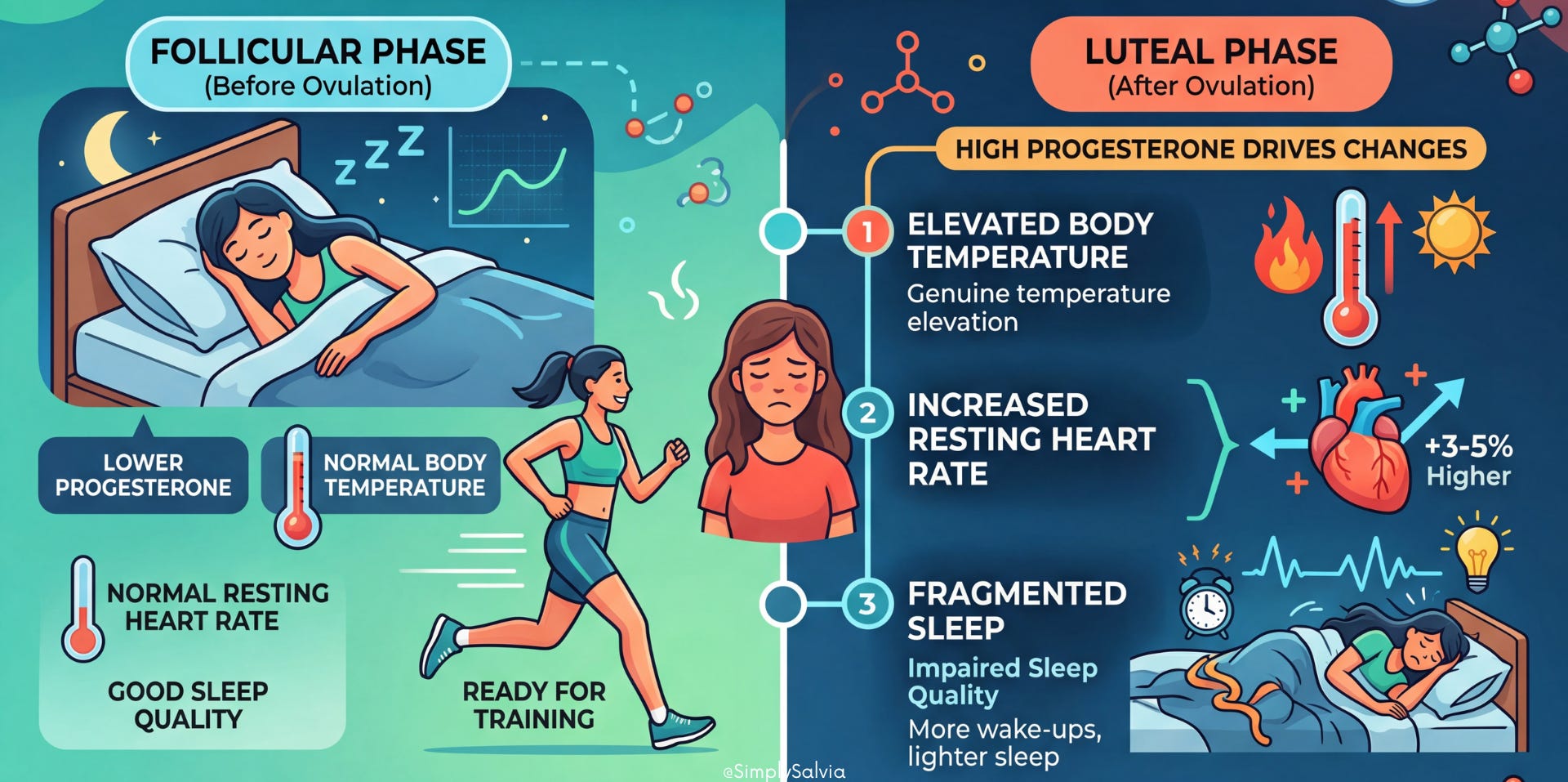
The progesterone-driven temperature elevation of the luteal phase genuinely impairs sleep quality. Elevated body temperature, increased resting heart rate (3-5% higher), and more fragmented sleep in the luteal phase are documented. A demanding training session on top of already-fragmented sleep, in a phase where the nervous system is more reactive to cortisol, may be a different experience in your body than the same session in the follicular phase even if your measured performance is similar.
The Harvard Women’s Health Study analysed 22.85 million logged workouts across 461,163 cycle days and found that women actually exercise very similar amounts in both phases; 21 minutes per day in the follicular phase versus 20.9 in the luteal. People are listening to their bodies and self-adjusting without being told to. That’s the practical version of cycle syncing, and it turns out women are largely already doing it.
What This Means Practically
The sports science evidence says: your hormonal phase is unlikely to determine whether you perform better or worse at the gym. What it may affect is how hard training feels and how well you recover from it.
The cycle syncing advice to “push hard around ovulation” and “back off in the luteal phase” is not well-supported for performance outcomes. But the advice to “listen to your body across the month and adjust intensity based on how you actually feel” is not only well-supported, it’s what the Harvard data shows women are already doing intuitively.
The more useful reframe: cycle syncing is less about following a prescribed exercise programme and more about giving yourself permission to train differently in different weeks without thinking something is wrong with you. The permission-giving is the valuable part. The specific programme is the oversimplified part.
Chapter 3: Hormones and How They Actually Change Your Body Across the Month
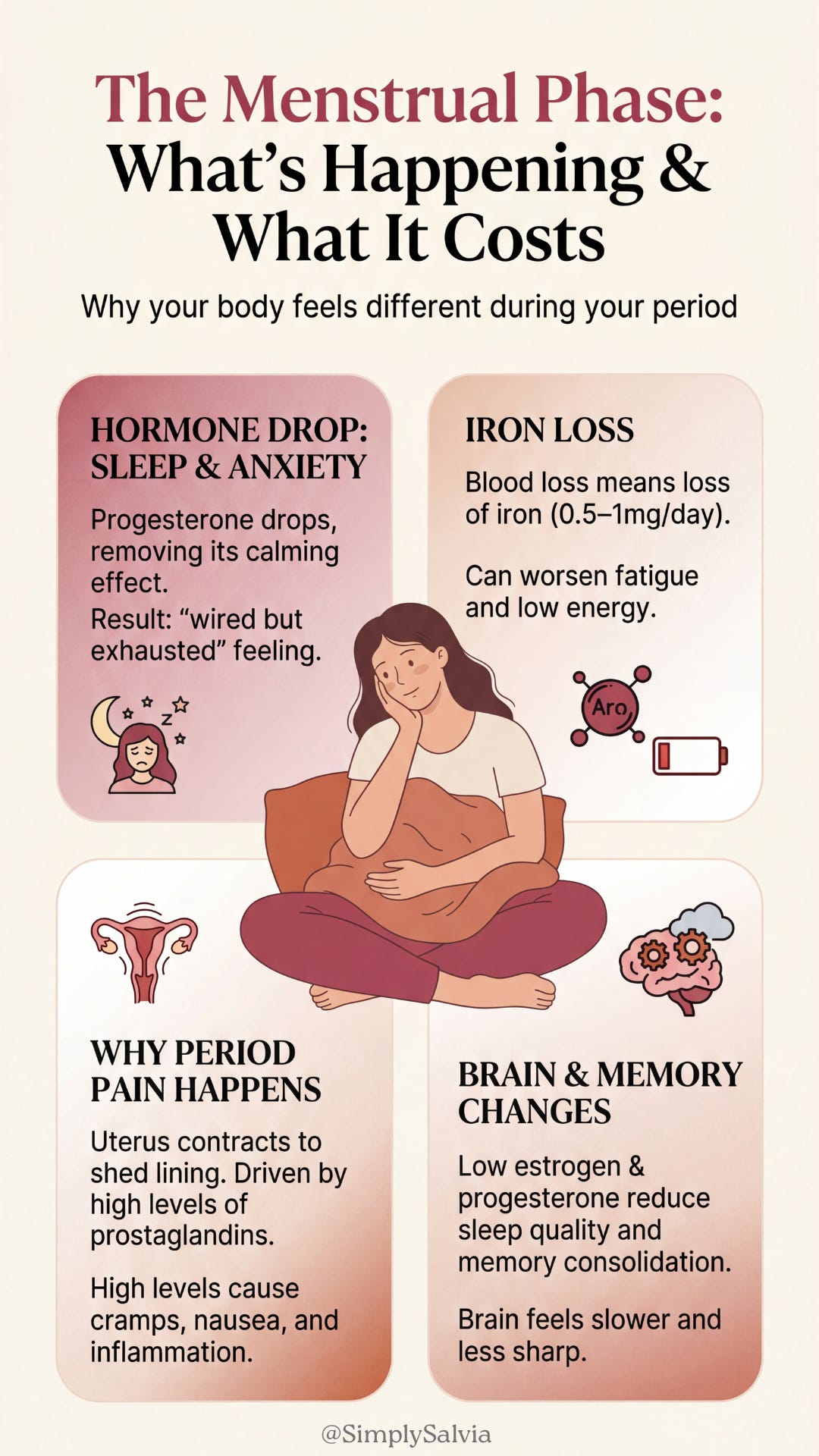
The Menstrual Phase: What’s Happening and What It Costs
When estrogen and progesterone drop sharply, several things happen simultaneously:
Why you can’t sleep the week before your period and why you feel wired and exhausted at the same time. During the second half of your cycle, progesterone produces a mild calming effect in your brain. It works through the same pathway that anti-anxiety medications and sleep aids target. That’s why many women feel genuinely sleepier in the weeks after ovulation — your body is producing its own mild sedative.
Then, right before your period, progesterone drops off sharply.
And that calming effect disappears with it.
Your nervous system, which had that chemical support, suddenly doesn’t. The result is a kind of rebound, heightened anxiety, difficulty falling asleep, a restless, on-edge feeling that doesn’t have an obvious cause. The “wired but exhausted” state that so many women describe in the week before their period isn’t a mood or a mindset. It’s your brain chemistry changing underneath you.
Iron loss. Menstruation involves blood loss, and blood contains iron-rich haemoglobin. Average menstrual blood loss depletes approximately 0.5–1mg of iron per day of bleeding in a typical period, significantly more with heavy periods. For a population that already has an iron deficiency rate of 40% among teenage girls (with 83.6% of cases missed by routine screening), this monthly loss is clinically relevant.
Why your period actually hurts. Your uterus doesn’t shed its lining passively. It contracts to push it out and those contractions are driven by chemicals called prostaglandins. The higher your prostaglandin levels, the stronger the contractions, and the worse the cramping.
But prostaglandins don’t stay neatly in the uterus. They also trigger inflammation, nausea, diarrhoea, headaches, and general flu-like misery. If your periods leave you feeling genuinely unwell and not just uncomfortable, but actually sick, prostaglandins are almost certainly why. This is not a low pain threshold. It’s a real physiological process with measurable effects on the body.
Reduced memory consolidation. Research by Genzel et al. found that women’s memory consolidation during sleep is poorest in the early follicular/menstrual phase. When both estrogen (which enhances sleep spindle activity) and progesterone (which also drives spindle activity) are low.
The Follicular Phase: Your Best Week
This is the good week. And there’s a reason for it.
As estrogen rises, your brain starts producing more serotonin, which is why your mood lifts, things feel more manageable, and you generally feel more like yourself. Your memory is sharper. Your energy is more consistent. Your sleep is deeper and more restorative. Your body temperature is lower, which sounds random but actually matters a lot for how well you sleep.
Appetite drops a little too. Research has found women naturally eat slightly less in the lead-up to ovulation, partly because estrogen quietly suppresses hunger. That’s not a bad thing. It’s just your body doing its thing.
In short: this is the phase where everything feels easier. Because hormonally, it is.
Ovulation: The 48-Hour Window
Ovulation itself is a brief moment, usually 24 to 48 hours. Estrogen is at its absolute peak, and energy and motivation tend to match it.
One thing worth knowing if you work out: research has found that joint laxity (how loose your ligaments are) is highest around ovulation. Estrogen triggers a hormonal chain reaction that softens connective tissue slightly, including in the knee. This is part of why women tear their ACL at 2 to 8 times the rate of men in the same sports. It’s not a reason to avoid training, but it is a reason to warm up properly and pay extra attention to form when you’re doing anything with jumping, heavy squats, or sharp directional changes.
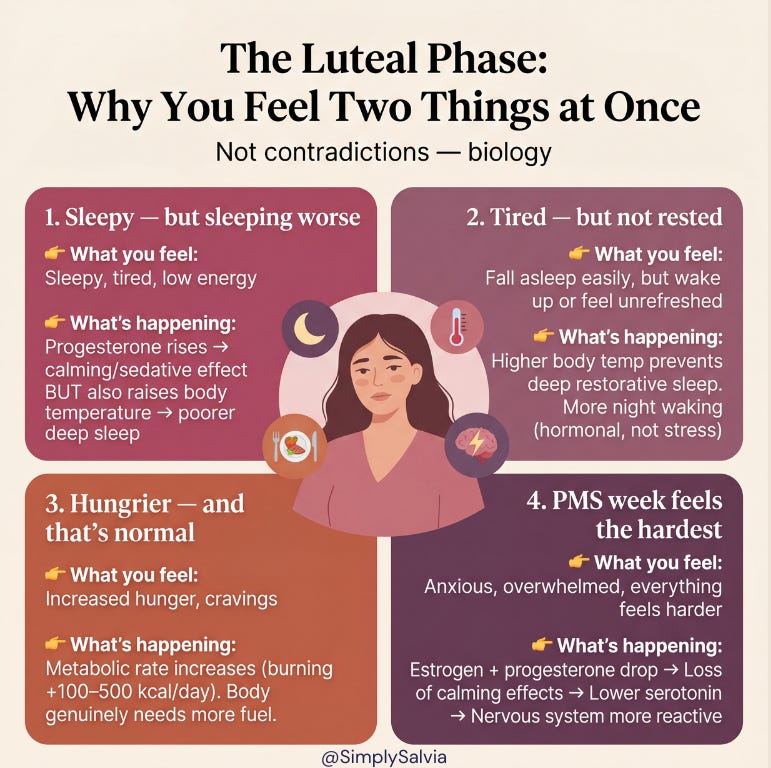
The Luteal Phase: Why You Feel Two Things at Once
This is the phase where cycle syncing content gets the most interest and where the biology is most complex and most misrepresented.
Here's the thing that confuses people: in the luteal phase, you feel sleepier and sleep worse. You feel more tired and actually need more food. You're doing less and your body is working harder. These are not contradictions. They're all happening at once, and there's a reason for each of them.
Why you feel sleepy:
After ovulation, progesterone rises and produces a mild sedative effect in the brain. The same chemical pathway that sleep medications target. So the sleepiness is real.
Why sleep is still rubbish:
At the same time, progesterone raises your body temperature by about half a degree. That doesn’t sound like much but it matters as your body needs to cool down significantly to get into deep, restorative sleep. When your baseline temperature is already elevated, it can’t cool down as far, and you end up in lighter, more broken sleep. Tired enough to fall asleep, but not sleeping deeply enough to actually feel rested. Research from Harvard found that the faster progesterone rises after ovulation, the more women wake up in the middle of the night. Not because of stress or your phone but because of hormones.
Why you’re hungrier and that’s fine:
Your resting metabolic rate actually increases in the luteal phase. Your body is burning roughly 100–500 more calories per day just existing. The hunger is your body asking for more fuel because it genuinely needs more fuel. Eating more in this phase is not a willpower problem. It’s biology.
Why the week before your period is the worst:
As your period approaches, both estrogen and progesterone drop off sharply. That drop removes the sedative progesterone effect and lowers serotonin at the same time so your nervous system loses two of its calming supports within the same few days. The result is the heightened anxiety, broken sleep, and “everything feels harder” experience that most women just call PMS, without realising it has a very specific neurochemical explanation.
It’s not in your head. It’s your hormones withdrawing.
Now you know more about your cycle than most of the people making content about it.
You know that the four phases are real biology, not a wellness framework someone invented. You know that the exercise research doesn’t actually support the phase-specific training prescriptions but does explain why some weeks feel genuinely harder than others. And you know what’s happening hormonally in each phase: why the follicular phase feels like a reset, why the luteal phase makes you sleepy and wrecks your sleep, and why the week before your period feels like the floor has dropped out.
That’s the why. Part 2 is the what to do about it.
Because here’s the thing: understanding your cycle is only half the equation. The more useful half is knowing which nutritional interventions the research actually supports — not the made-up ones, but the ones with real clinical evidence behind them. Knowing how to train in a way that works with your hormonal environment rather than against it. Knowing how to track your own pattern rather than following a generic programme that was built for someone else’s cycle. And having a phase-by-phase guide you can actually use.
Part 2 covers all of it.
Chapter 4 is the nutrition chapter. What the research genuinely supports eating in each phase, and what’s marketing dressed up as science. The difference is bigger than you’d think, and the evidence-backed version is simpler and more useful than the programme.
Chapter 5 reframes the whole conversation, from cycle syncing as a rigid protocol to cycle awareness as a way of understanding your body. This is the shift that makes everything else actually work.
Chapters 6–9 are the practical half: the workout framework, the tracking guide, and the phase-by-phase summary you can save and actually refer back to month by month.
Part 2 is for paid subscribers. If you’re not one yet, you can upgrade below.
The information in this post is for educational and informational purposes only. None of the above constitutes medical advice, a diagnosis, a treatment recommendation, or a substitute for consultation with a qualified healthcare professional. Always seek the guidance of your doctor or another qualified health provider with any questions you may have regarding your health.
Sources & Further Reading
Pfender, Wanzer et al. Sync or Swim: Navigating the Tides of Menstrual Cycle Messaging on TikTok — Perspectives on Sexual and Reproductive Health, 2025
Pfender, Kuijpers et al. Cycle Syncing and TikTok’s Digital Landscape: A Reasoned Action Elicitation — Qualitative Health Research, 2025
McNulty et al. The Effects of Menstrual Cycle Phase on Exercise Performance in Eumenorrheic Women: A Systematic Review and Meta-Analysis — Sports Medicine, 2020
Colenso-Semple et al. Current evidence shows no influence of women’s menstrual cycle phase on acute strength performance or adaptations to resistance exercise training — Frontiers in Sports and Active Living, 2023
Wen, Gao et al. Exercise performance at different phases of the menstrual cycle: a narrative review — Frontiers in Endocrinology, December 2025
Harvard Apple Women’s Health Study: Exploring Exercise Habits by Menstrual Cycle Phase, 2025
Evidence for Periodizing Strength and/or Endurance Training According to the Menstrual Cycle — Strength & Conditioning Journal, December 2025
Weyand et al. Iron Deficiency in Girls and Women — JAMA, 2023
Shiff et al. Objective Sleep Interruption and Reproductive Hormone Dynamics in the Menstrual Cycle — PMC, Harvard, 2014
Baker et al. Tracking Sleep, Temperature, Heart Rate, and Daily Symptoms Across the Menstrual Cycle with the Oura Ring — PMC, 2022
Facchinetti et al. Magnesium prophylaxis of menstrual migraine — Headache, 1991; Magnesium and PMS
Moghadamnia et al. Effect of fish oil on dysmenorrhea — Iranian Journal of Nursing and Midwifery Research, 2010
Nutrition and the Menstrual Cycle — Clue Health Platform, evidence review
Worldhealth.net: Cycle Syncing — Separating Social Media Hype From Real Hormone Health, 2025
The phrase "more useful than anyone is telling you" is doing a lot of work here, and I mean that as a compliment — it's rare to see someone hold the complexity of cycle syncing without either dismissing it entirely or overselling it. The middle path you're navigating, between real evidence and real lived experience, is where I find the most interesting conversations happen. I especially sat with the section on energy variation — because the thing that changed most for me wasn't what I scheduled, it was that I stopped apologizing for the variation itself.