


okay so I need to talk about something.
I’m bloated like four days a week. My stomach goes from flat in the morning to “are you pregnant” by evening for absolutely no reason I can identify. I’ve had random stomach pain that comes and goes. I’ve had weeks where I couldn’t poop and weeks where I couldn’t stop. I’ve Googled “why is my stomach always weird” more times than I’d like to admit.
And apparently I’m not alone, because #hotgirlshaveibs has over 112 million views on TikTok.
That number is funny to say out loud, but it’s also telling us something real: gut problems are so common in young women that we made a whole meme about it. Bloating, constipation, random stomach pain, IBS, these are being treated as an inherent part of having a female body, like cramps. Just a thing that happens. Nothing to do about it.
Except there’s actually a lot of research on why this is happening. And it’s more interesting than “women just have sensitive stomachs.” There’s a reason IBS affects women at twice the rate it affects men. There’s a reason your gut feels totally different in different weeks of the month. There’s a reason stress literally gives you stomach pain.
This short dive is the explanation your body has been waiting for. What’s actually going on, why it’s specifically worse for us, and what you can actually do about it.
Your Gut and Your Brain Are Basically in a Group Chat
Why Women Specifically Got the Worst Deal Here
What "Gut Health" Actually Means (And What It Doesn't)
The Bloating Chapter (Finally)
What to Eat (And What's Probably Making Things Worse)
Your Gut and Your Skin Are Talking To Each Other
The Cycle-Aware Gut Protocol
The Practical Guide: Probiotics Decoded and the Daily Habits
The Short Version of Everything
Chapter 1: Your Gut and Your Brain Are Basically in a Group Chat
Okay so picture this: you have a big exam coming up. Or a difficult conversation you’re dreading. And your stomach feels it before anything has even happened. The knot, the sudden need to run to the bathroom, the weird nausea that shows up when you’re stressed. That’s not a coincidence or a personality quirk. That’s biology.
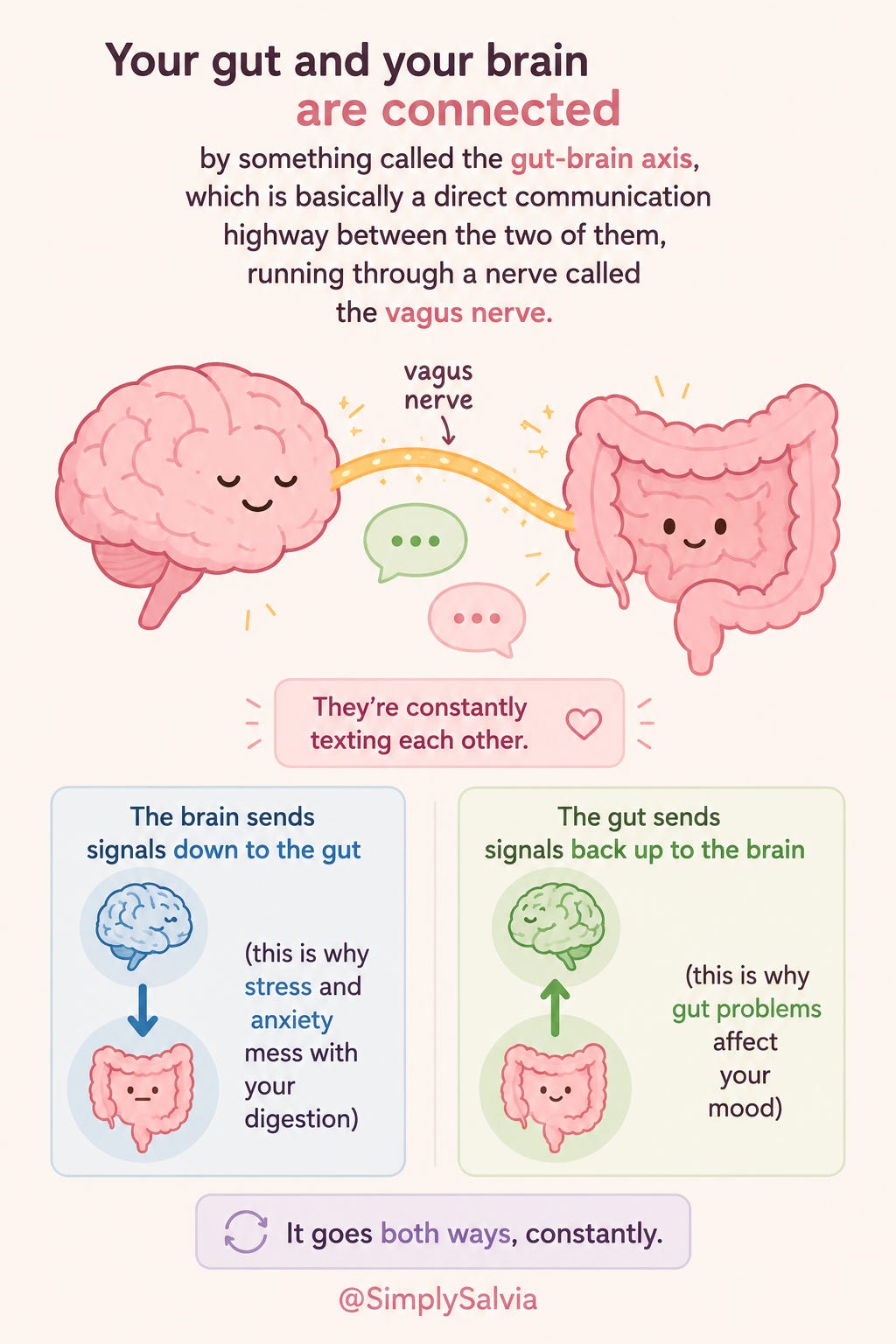
Your gut and your brain are connected by something called the gut-brain axis, which is basically a direct communication highway between the two of them, running through a nerve called the vagus nerve. They’re constantly texting each other. The brain sends signals down to the gut (this is why stress and anxiety mess with your digestion). The gut sends signals back up to the brain (this is why gut problems affect your mood). It goes both ways, constantly.
Here’s what makes this even more interesting: your gut has its own nervous system. Like, an independent one. It has more nerve cells than your spinal cord, around 500 million of them and it can operate semi-independently of the brain. Scientists sometimes call it the “second brain,” which sounds dramatic but is actually just anatomically accurate. The gut is not just a tube that moves food. It’s a complex sensory organ that’s in constant conversation with everything else.
And living inside that gut? About 38 trillion bacteria, fungi, and other microorganisms that collectively make up your gut microbiome. These aren’t just sitting there. They’re actively producing neurotransmitters including about 90–95% of the body’s serotonin (yes, the mood chemical, mostly made in your gut, not your brain), GABA (the calming neurotransmitter your anxiety chapter covered), and dozens of other compounds that affect how you feel mentally and physically. The gut microbiome is, in a very real sense, part of your emotional regulation system.
This is why “gut health” isn’t a wellness trend invented to sell supplements. It’s a genuinely important area of research with implications that go way beyond digestion. When your gut bacteria are diverse and well-fed, the whole system tends to work. When they’re disrupted through a bad diet, antibiotics, chronic stress, not sleeping, the effects ripple outward into your mood, your skin, your hormones, and yes, your digestion.
The #hotgirlshavestomachissues meme exists because the gut-brain axis is more active in young women than most of us realise, in a hormonal environment that specifically makes it more reactive. Which brings us to chapter 2.
Chapter 2: Why Women Specifically Got the Worst Deal Here
Women are twice as likely to have IBS as men. Twice. And symptoms peak between ages 18 and 39.
For a long time, medicine didn’t have a great explanation for this. The assumption was that women were more likely to report symptoms, or that psychological factors explained the gap, or just that women had more “sensitive” guts in some vague way that nobody could really explain.
Then in December 2025, researchers at UC San Francisco published a study in the journal Science that finally gave us the mechanism. And it’s estrogen.
But not in the way you might think.
The estrogen finding that changed everything
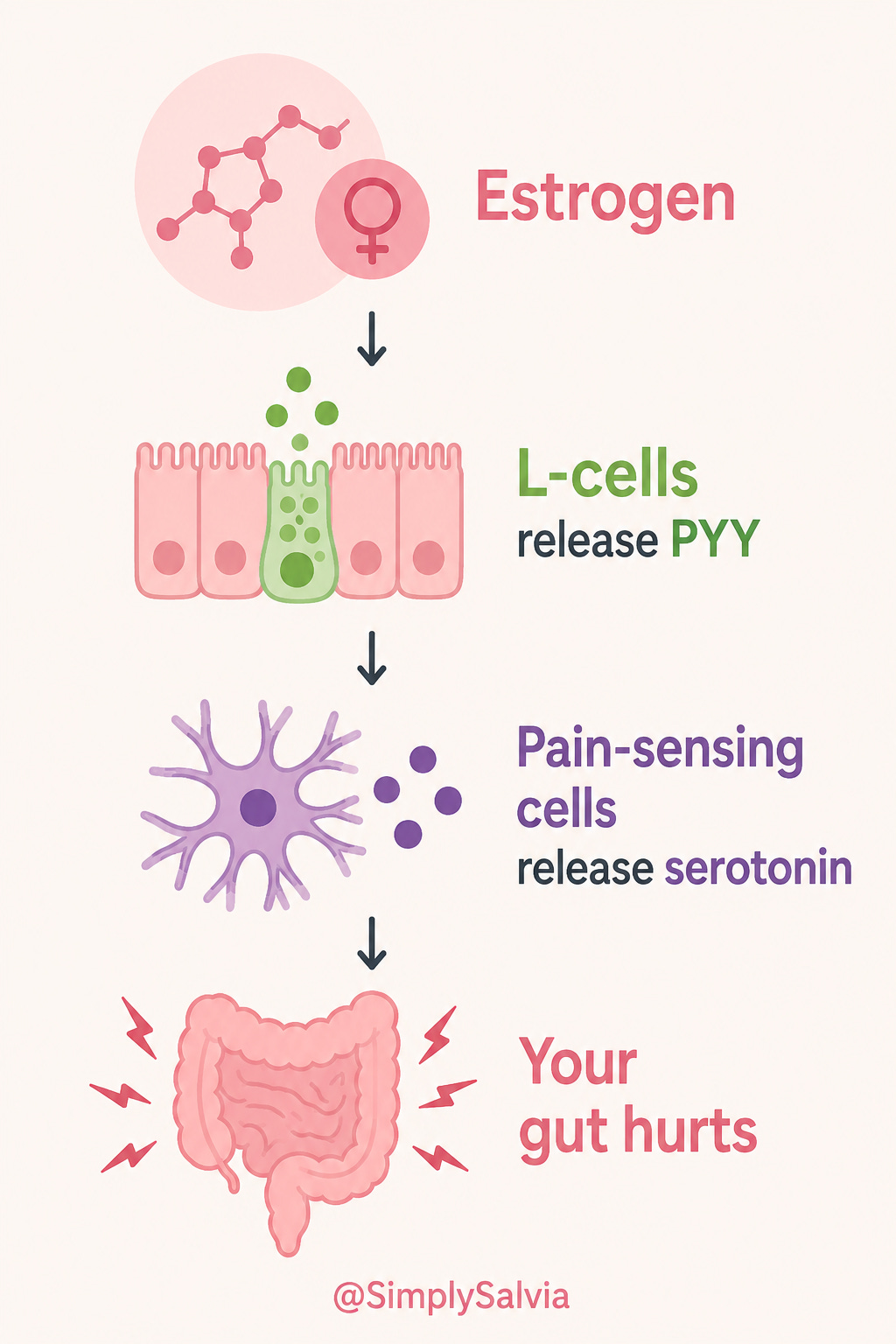
The researchers were looking at a specific type of cell in the colon called L-cells. These cells normally release hormones related to appetite and gut movement. What the researchers found was that estrogen binds to receptors on these L-cells, and when it does, it triggers the release of a hormone called PYY, which then tells nearby pain-sensing cells to flood the area with serotonin.
Serotonin in the gut (not the mood version, a different mechanism) activates the pain-sensing nerve fibres that send “something’s wrong here” signals to your brain. So the chain looks like this:
To prove it was actually the estrogen doing this, they gave male mice estrogen doses equivalent to female levels. The male mice’s gut pain sensitivity immediately increased to match that of females.
Here’s the second part that explains so much: estrogen also caused those L-cells to produce more receptors for the byproducts of gut bacteria fermenting food specifically the fermentation of things like onions, garlic, beans, and wheat (what dietitians call FODMAPs). So estrogen isn’t just making the gut more pain-sensitive in general. It’s also making it more reactive to specific foods that produce gas and fermentation.
This is the mechanism behind two things that confuse a lot of women:
Why your gut reacts to foods that don’t bother other people — estrogen has specifically made your gut more sensitive to those fermentation byproducts
Why gut symptoms often change across your cycle — because estrogen levels change across your cycle, and so does gut sensitivity
The cycle-bloating connection
This is where it gets really specific and really useful.
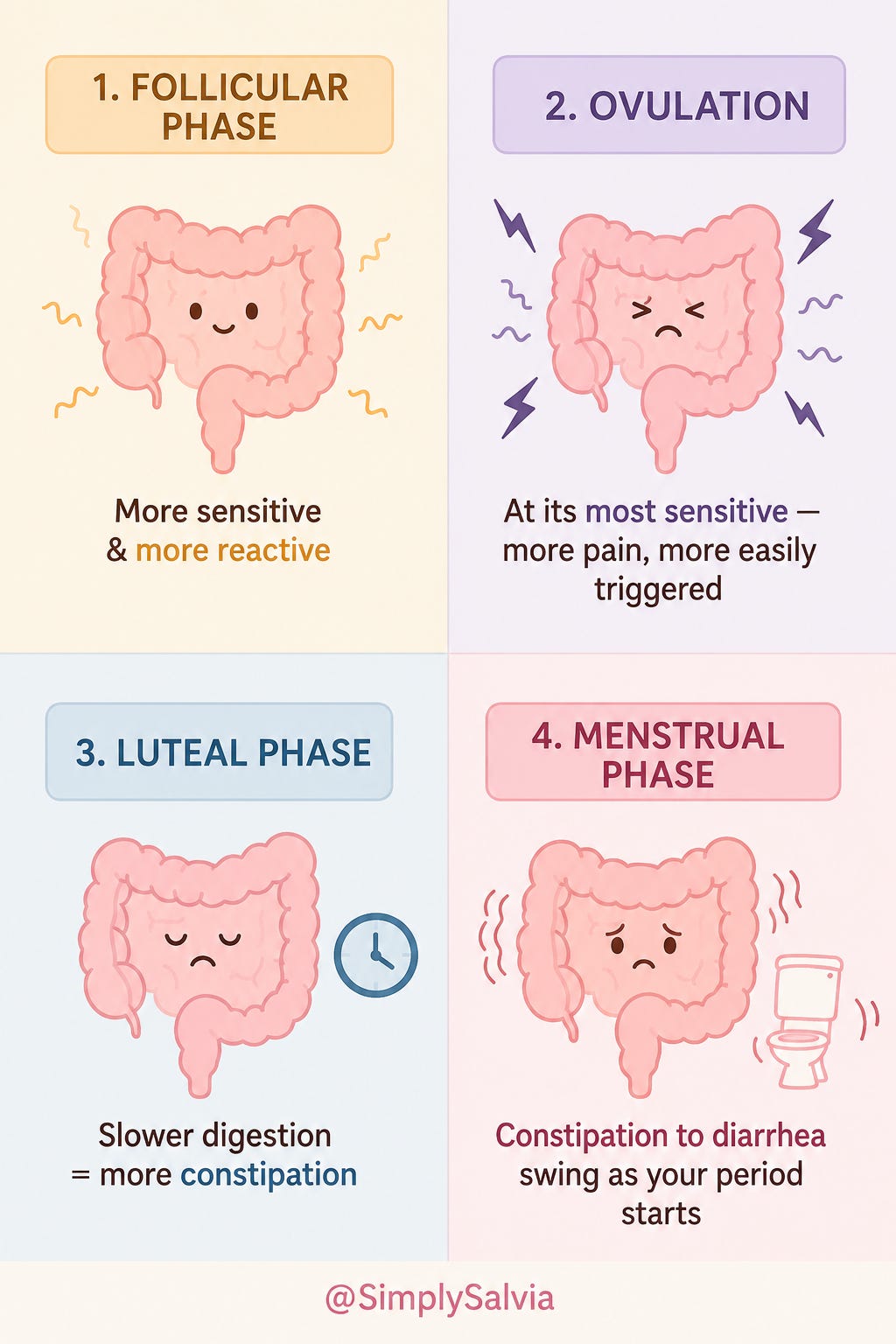
In your follicular phase (after your period ends, leading up to ovulation), estrogen is rising. The gut is more sensitive because of the mechanism above. Some women notice their stomach is more reactive in this phase than they expect.
Around ovulation, estrogen peaks, this is when the gut is at its most sensitive, and some women have their worst gut pain here even though they don’t associate it with the premenstrual window at all.
In the luteal phase (after ovulation, the two weeks before your period), progesterone takes over. And here’s what progesterone does to your gut: it slows everything down. Literally. It slows the contractions that move food through your intestines. This is why constipation is specifically worse in the two weeks before your period, progesterone is basically putting the brakes on your digestion.
Then as you get close to your period, prostaglandins kick in, the compounds that drive uterine contractions to start your period. They also affect your intestines. Which is why, right when your period starts, many women swing from constipation to diarrhea. Your intestines are responding to the same signal your uterus is.
And throughout all of this: the composition of your gut microbiome itself changes across your cycle. The bacteria that thrive in different hormonal environments are actually different bacteria, which is why your stomach can feel so variable month to month even if you’re eating the same things.
The anxiety loop
There’s one more piece that rounds out the “why women” picture. Women experience anxiety at twice the rate of men (covered in the anxiety short dive). And anxiety directly activates the gut-brain axis. The stress response tells the gut to change how fast things move, which changes the bacterial environment, which changes which signals go back to the brain.
This is why the TikTok meme exists. It’s not a coincidence that “hot girls have stomach issues” overlaps almost exactly with “young women have the worst mental health of any demographic.” The anxiety is activating the gut. The gut is feeding back into the anxiety. It’s a loop.
And once you understand that the loop exists, you can start intervening at both ends of it.
Chapter 3: What “Gut Health” Actually Means (And What It Doesn’t)
“Gut health” has become one of those wellness terms that means everything and nothing simultaneously. Let’s sort it out.
What it actually means
Your gut microbiome is healthy meaning it’s diverse, when it contains a wide variety of bacterial species that are collectively able to:
Ferment dietary fibre into short-chain fatty acids (these are the compounds that reduce inflammation, maintain the gut lining, and communicate with the immune system)
Metabolise estrogen properly through the estrobolome (so hormones are cleared correctly rather than recirculating)
Produce adequate GABA and serotonin precursors for the gut-brain axis
Maintain the integrity of the gut lining (preventing the “leaky gut” situation where compounds that shouldn’t cross into the bloodstream do)
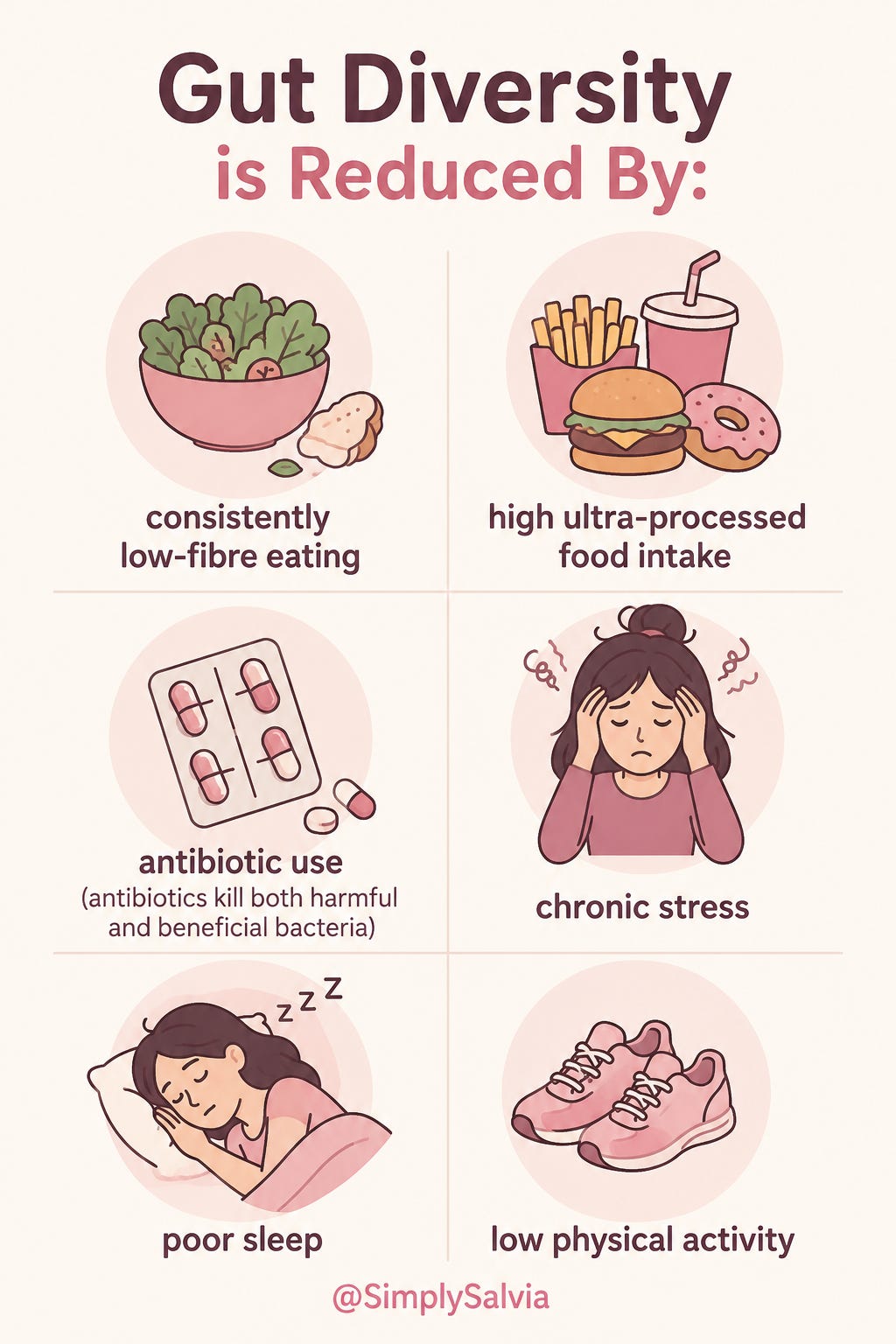
All of these are extremely common in the 15–35 age group.
What “gut health” doesn’t mean
It doesn’t mean your gut is a glass that you can “clean” or “detox.” Your gut is not dirty. You cannot flush it. Juice cleanses and “gut reset” programmes don’t remove bacteria, they temporarily change the environment, and your bacteria largely return to their previous composition within a few weeks because bacteria adapt quickly.
It doesn’t mean that fermented food alone fixes everything. Kefir is great. It is not going to compensate for a diet with almost no fibre.
It doesn’t mean every gut problem has a dietary solution. Some gut conditions like Crohn’s disease, ulcerative colitis, coeliac disease, SIBO, gastroparesis, are medical conditions that require medical diagnosis and management. Persistent, severe, or new-onset gut symptoms that affect your quality of life should be investigated by a doctor, not just managed with probiotics. The TikTok meme normalises talking about gut issues, which is good. It should not normalise ignoring symptoms that need investigation.
The fibre gap you probably have
The single most impactful thing for gut microbiome diversity is dietary fibre specifically the variety of fibres that comes from eating a range of plant foods. Current recommendations are 25–38g of fibre daily. Most people in Western countries eat less than half of this.
This isn’t about eating more salad. It’s about variety. Different plant fibres feed different bacterial species. The research consistently shows that the most diverse gut microbiomes come from people who eat the widest variety of plant foods and not the people who eat the most of one specific “gut health” food. The goal is 30 different plant types per week, including vegetables, fruits, legumes, nuts, seeds, herbs, and wholegrains. This sounds like a lot until you realise that three different colours of bell pepper count as three, and a handful of mixed seeds counts as several.
That’s Part 1. Part 2 is where I get into the specific stuff: the bloating chapter with what actually makes it worse and what actually helps, what to eat (and stop eating), how your gut and your skin are connected in ways that explain a lot, the cycle-aware gut protocol, and the practical guide to probiotics that doesn’t just say “take a probiotic.”
So now you know what’s actually going on. Your gut and your brain are in a constant two-way conversation that affects your mood, your skin, your digestion, and your hormones. Estrogen specifically makes your gut more pain-sensitive through a mechanism that researchers only fully mapped in December 2025, meaning the “why does this hurt me more than everyone else” question finally has a real answer. And “gut health” isn’t a vibe. It’s a specific biological state with specific things that support or disrupt it.
Part 2 is the practical half.
Chapter 4 is the bloating chapter. The actual causes of each type of bloating (they’re different), what makes them worse, what the research says actually helps, and why most of the bloating advice you’ve seen is addressing the wrong thing.
Chapter 5 is what to eat. Not a meal plan. The specific foods and eating patterns with actual research behind them for gut health and the specific things that are probably making your gut worse right now.
Chapter 6 is the gut-skin connection, for anyone whose skin problems haven’t fully responded to topicals. The route from gut bacteria to estrogen to jawline acne is documented, and this is the chapter that explains it properly.
Chapter 7 is the cycle-aware gut protocol. What to do differently in each phase because your gut is genuinely different in each phase.
Chapter 8 is the practical guide: probiotics decoded (the strain thing matters and most people don’t know this), what supplements actually have evidence, and the daily habits that make the most difference.
Subscribe to read Part 2 →
Sources & Further Reading
UCSF — Do Hormones Explain Why Women Experience More Gut Pain? December 2025
MedicalXpress — IBS affects women more than men — here’s why, October 2025
Digestive Diseases and Sciences — It’s a Women’s World: Sex Differences in IBS, March 2025
Mayo Clinic Proceedings — Sex and Gender Differences in Functional Gastroenterologic Disorders, 2021
Evelyn Health — PMS and gut health: what your digestive symptoms are telling you, June 2026
Frontiers in Microbiology. Psychobiotics in mental health: gut-brain axis insights, March 2026
Osprey Polyclinic. The gut-hormone connection for women, February 2026
Fortune — The hot girls have stomach issues social media trend makes sense, 2023