


Part 1: The Biology, The Paradox, The Cycle, The Pill
You’ve been told to sleep 7–9 hours. You’ve fixed your routine. You’ve put your phone down. And you still wake up tired. This isn’t a discipline problem. It’s a data problem. The data just wasn’t collected on you.
This is Part 1 of a two-part Deep Dive. It covers the foundational research, the hormonal architecture of female sleep, how your sleep changes across the menstrual cycle, and what happens when you’re on the pill. Part 2 covers why you’re still tired, the sleep disorders being missed in women, what actually works, and your full action plan.
There’s a specific kind of tired that doesn’t have a name.
Not the tired that comes from a late night out. Not the tired that a weekend of good sleep fixes. Not the tired that lifts after a holiday when you finally stop setting an alarm and let your body find its own schedule.
This kind is different. It’s the tired that’s just there when you wake up — before the day has asked anything of you, before the first obligation, before coffee. A baseline heaviness that’s been present since your mid-teens and has never really gone away. Some weeks it’s manageable. Some weeks it’s not. Some months your sleep feels genuinely good and you think you’ve finally cracked it, and then it falls apart again, on a schedule you can’t quite identify.
You’ve done the things. You know about sleep hygiene. You’ve heard about blue light and consistent bedtimes and the importance of winding down and not being on your phone after 10pm. Some of you have read the books. Some of you have downloaded the apps. Some of you have made actual spreadsheets.
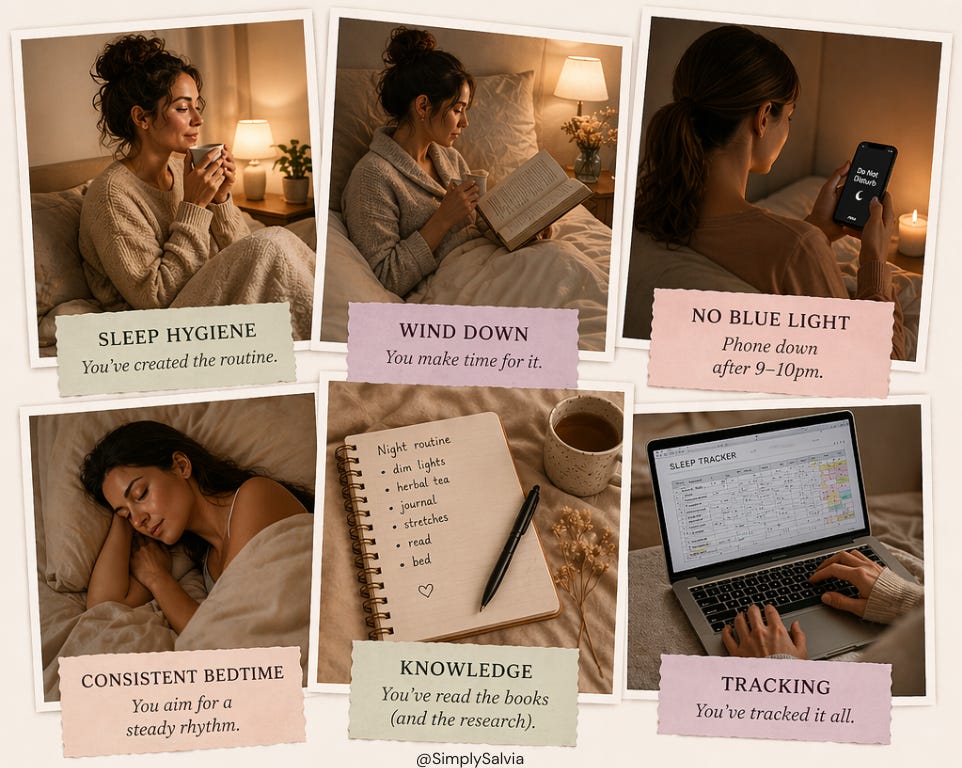
And you still wake up tired on half the mornings of your life, for no clear reason, doing everything right.
At some point, this stops feeling like a habit problem. At some point, it starts feeling like something is actually wrong with you. Like your body has a fundamental incapacity for good sleep that other people seem to have figured out. Like you’re broken in a way that’s not dramatic enough to be a condition but persistent enough to quietly undermine your life.
Here’s what I want to tell you before anything else: you’re not broken. But the advice you’ve been given is incomplete, in a very specific way, about a very specific thing, that has a very specific explanation.
The 7–9 hours recommendation has been given to you since you first complained about being tired in school. It comes from the CDC, the NIH, the National Sleep Foundation. It’s backed by decades of research.
It also comes, largely, from research conducted on men.
And a 2024 landmark review published in Sleep Medicine Reviews by researchers from Stanford University, Harvard Medical School, and the University of Southampton found that females are
“often underrepresented in sleep and circadian research”
and that the gap between the biology the science was built on and the biology it’s being applied to has real, measurable consequences. The same study found that women’s intrinsic circadian periods are shorter than men’s by around six minutes, and that the resulting misalignment between biological and social sleep timing is approximately five times larger in women than in men.
Five times.
The sleep advice that’s been failing you was built on a body that works differently from yours. The question that actually needs answering isn’t:
are you sleeping enough?
It’s:
are you sleeping in a body that the research has actually accounted for?
This Deep Dive is the answer to that question. Both parts, across 11 chapters, cover what the science actually says — not the simplified version that ends up in sleep hygiene articles, but the research on female sleep architecture, on how hormones interact with sleep, on how your sleep changes across the month in ways most people never have a framework for.
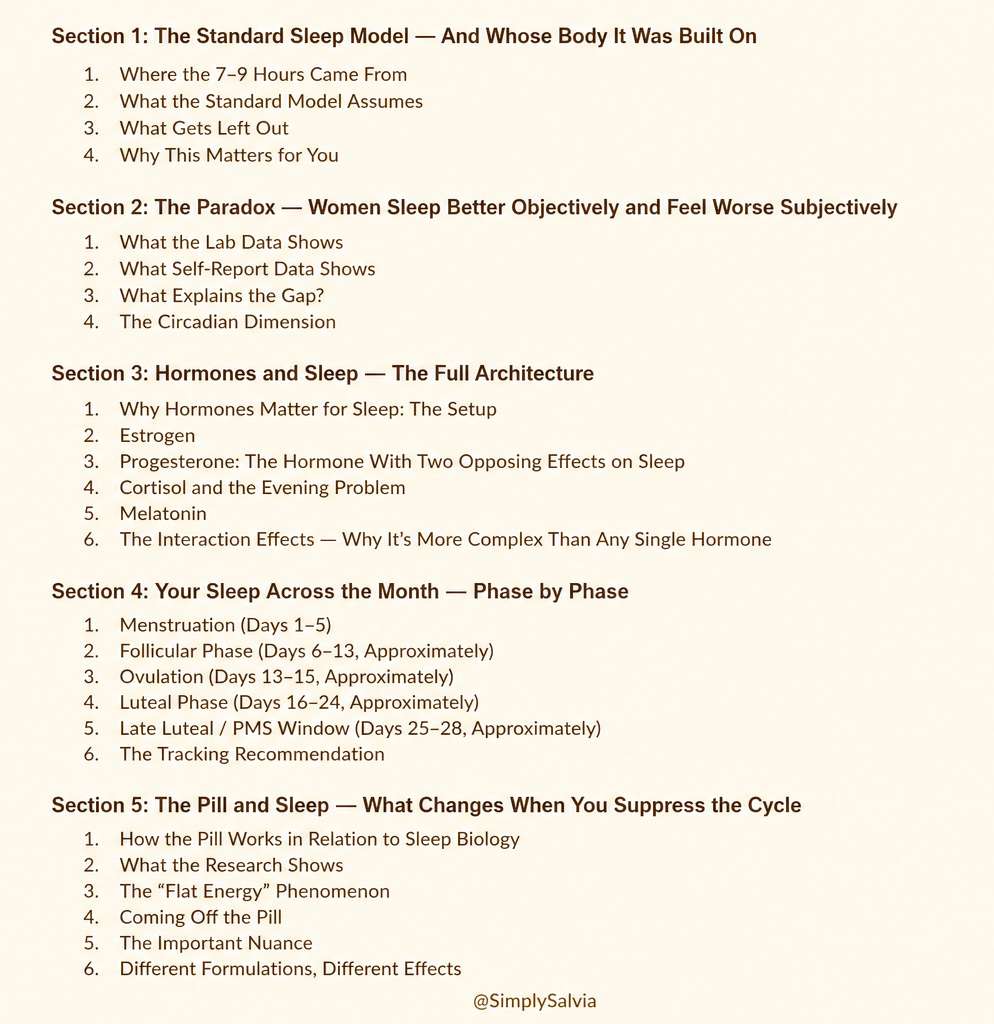
Part 1 covers:
Why the standard sleep model has a significant blind spot, and whose biology it was built on
The paradox: why women sleep better in the lab and feel worse in real life
The full hormonal architecture of female sleep — estrogen, progesterone, cortisol, melatonin — and what each one does while you’re supposed to be resting
How your sleep changes across the menstrual cycle, phase by phase
What happens to your sleep architecture on the pill — and coming off it
The tiredness you’ve been carrying isn’t a character flaw. It’s a biological experience that hasn’t been named properly yet.
Let’s name it.
PS: We also have a subscriber-only group chat where members discuss the deep dives, share their sleep journeys, and ask me questions directly. See you there.
Disclaimer: The information and opinions expressed above are current as of the date of this post and are subject to change without notice. Materials referenced above are provided for educational and informational purposes only. None of the above constitutes medical advice, a diagnosis, a treatment recommendation, or a substitute for consultation with a qualified healthcare professional. Always seek the guidance of your doctor or another qualified health provider with any questions you may have regarding a medical condition or sleep disorder.
Deep Dive below ↓
