


Every week, the science shifts a little — and this week, it stings a little too.
This edition of Between Saturdays is about the things we’re doing right now, tonight, without realising they’re costing us. The collagen we’re buying. The sleep we’re cutting short. The loneliness we’re numbing with our phones. And the thing that works better than medication for depression that most of us still aren’t taking seriously as an actual treatment.
The research this week isn’t gentle. But it is hopeful. And it’s all pointing to the same place: the habits that feel harmless or even self-caring aren’t always what they seem.
Let’s get into it.
Caught My Eye…
The Collagen Supplement Reckoning
If you’ve ever added collagen to your coffee, stirred it into your smoothie, or paid £30 for a bottle of marine collagen capsules, this one is for you.
A landmark meta-analysis published in The American Journal of Medicine in 2025 looked at 23 randomised controlled trials involving 1,474 participants and set out to do something no previous review had properly done: separate the studies funded by pharmaceutical companies from the ones that weren’t.
The finding? When you strip out the industry-funded research, the independent, high-quality trials show no significant benefit from oral collagen supplements for skin hydration, elasticity, or wrinkles. The studies showing improvements were predominantly low-quality and funded by the very companies selling the supplements. The researchers concluded there is “currently no clinical evidence to support the use of collagen supplements to prevent or treat skin aging.”
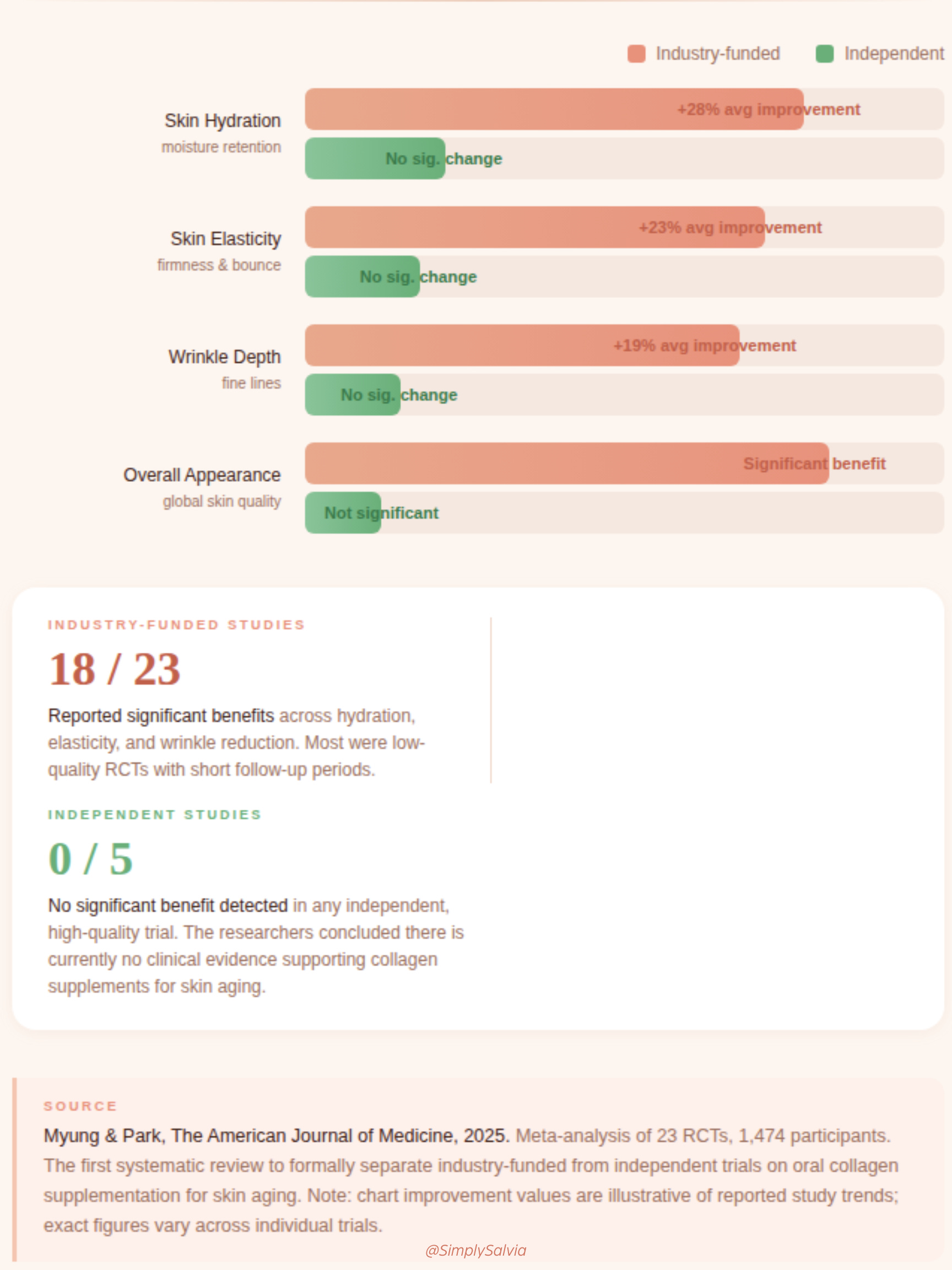
This doesn’t mean the science is settled — the collagen industry has pushed back, and some researchers have pointed to methodological issues in how the studies were categorised. A Tufts University dermatologist noted that oral collagen “can be considered” alongside other interventions, but is not currently recommended as a standalone treatment. The debate is ongoing.
What it does mean: the confident, unqualified marketing behind most collagen supplements is running well ahead of the independent evidence.
The irony? The thing most reliably destroying your body’s own collagen production is something the next story will get into. Spoiler: it’s free, and you’re probably not getting enough of it.
Your Body Repairs Itself at Night — But Only if You Let It
Here is something most skincare marketing never tells you: your skin has its own internal clock.
A 2025 review published in the journal Dermatology confirmed what researchers have been building toward for years — the skin is not just a passive barrier. It is an active, circadian-regulated organ with its own peripheral clock system that operates in sync with the body’s master circadian rhythm. During daylight hours, skin cells focus on protection: maintaining thickness, managing sebum, keeping the barrier intact against UV and pollution. At night, the skin shifts into repair mode. Collagen production increases. Cell turnover accelerates. DNA damage accumulated during the day gets corrected.
The catch? This whole system depends on sleep being regular and timed with natural light-dark cycles. Disrupted sleep, whether from late nights, inconsistent schedules, or the blue light flooding our screens after dark — throws the skin’s clock out of sync. When that happens, collagen production drops. The skin barrier weakens. Inflammation rises. Cellular repair slows.
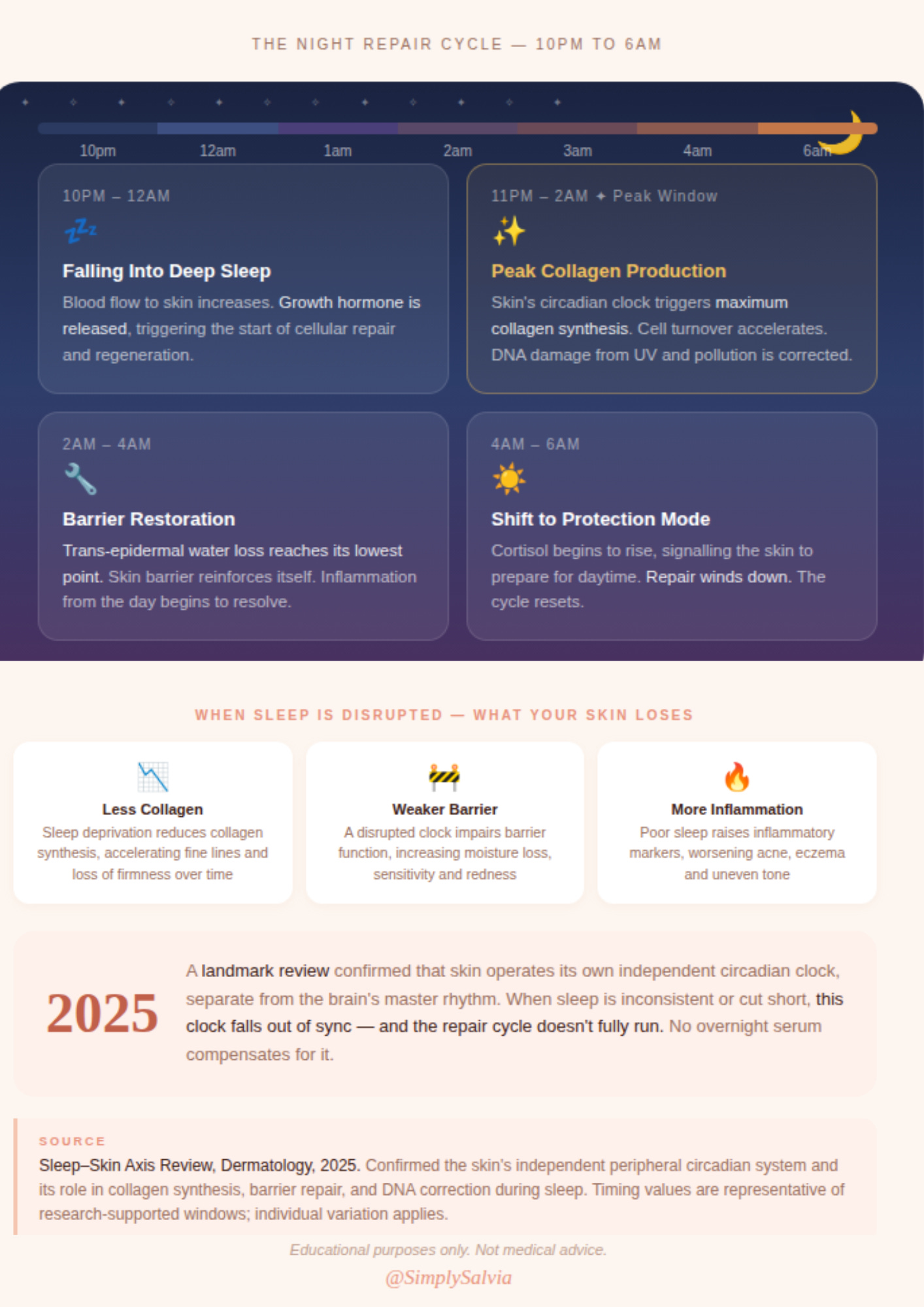
A separate study from 2025 found that sleep deprivation specifically disrupts the circadian rhythm of estradiol in women, impairing both skin barrier function and dermal collagen synthesis. In other words: poor sleep doesn’t just make you look tired. It is, over time, structurally aging your skin at a cellular level.
This is the connection most people miss when they’re spending money on supplements. You can buy collagen in a powder or a pill, but if your sleep is disrupted, your skin’s own collagen-producing machinery is already running at reduced capacity. The most effective overnight skincare routine might simply be getting to bed earlier and putting your phone away.
Exercise Works. Better Than We Thought. For Depression and Anxiety.
In February 2026, a research team published what may be the most comprehensive analysis of exercise and mental health ever conducted. The umbrella review, published in the British Journal of Sports Medicine, pooled data from 57 meta-analyses covering 800 individual studies and nearly 58,000 participants aged 10 to 90.
The conclusion: exercise reduces symptoms of depression and anxiety comparably to and in some cases better than psychological therapy. When compared directly to antidepressant medication, exercise showed similar benefits, though the evidence for that comparison was less certain and the researchers were careful to note the limitations. This isn’t a case of overselling it: exercise works, meaningfully, across all age groups, exercise types, intensities, and formats.
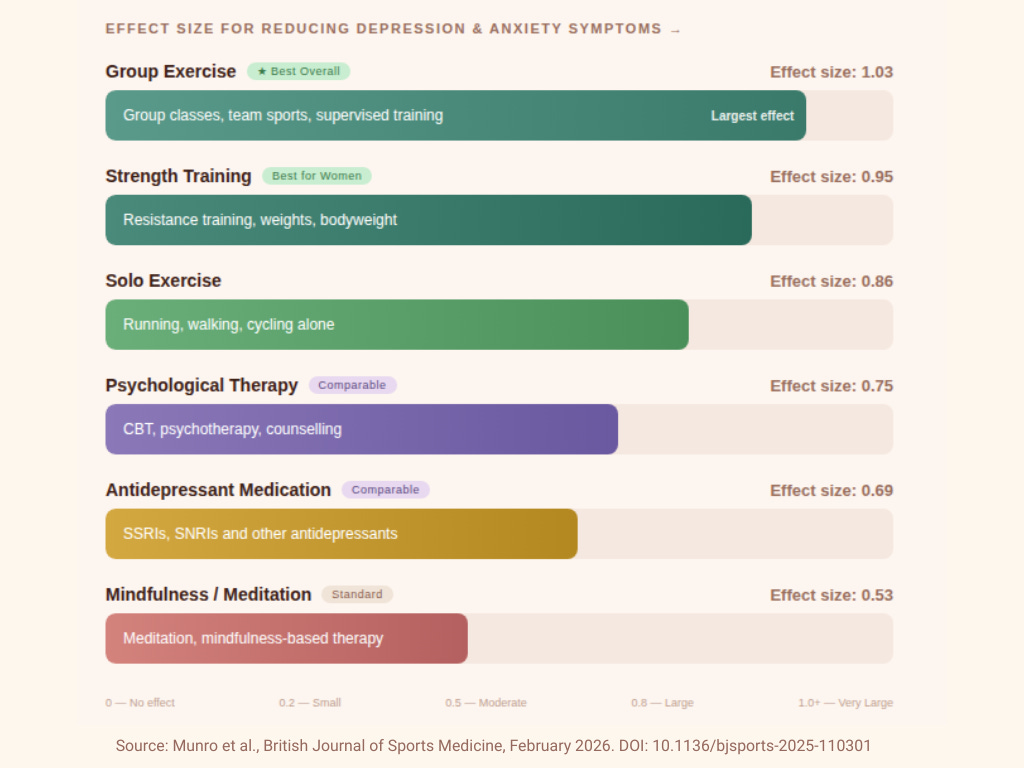
What made the findings particularly striking for our age group: the benefits were most pronounced for emerging adults aged 18–30 and for postnatal women. Young adulthood — the exact period when many mental health conditions first emerge is also the moment when exercise has the most to offer.
The social dimension matters too. Group exercise and supervised formats showed the largest benefits overall, suggesting that the mental health gains from movement aren’t just physiological. Being in a room with other people, moving together, is doing something that medication and solo workouts can’t fully replicate.
A note of nuance: experts have rightly pointed out that exercise is not a replacement for medication or therapy in all cases, particularly for severe depression. But for mild to moderate symptoms, the evidence now supports treating exercise with the same seriousness we give to clinical interventions. As the study’s authors put it:
“Mental health professionals should prescribe exercise with the same confidence as traditional treatments.”
That line hit me. We’re not talking about going for a walk to clear your head. We’re talking about structured movement as a clinical tool, with evidence strong enough to belong in the same conversation as an antidepressant prescription.
We Are the Loneliest Generation. Despite Being the Most Connected.
In 2025, the data on loneliness among young people stopped being surprising and started being undeniable.
The Cigna Group’s Loneliness in America 2025 survey, drawn from over 7,500 adults, found that 57% of Americans are lonely and that younger generations, specifically Gen Z and Millennials, report significantly higher rates than older adults. Gen Z came in at 67% classified as lonely. Millennials at 65%. The generations who have grown up with the most digital connectivity in human history are, by every measure, the least socially connected in terms of felt belonging.
A separate Gallup analysis found that young people aged 15–34 in the US reported feeling lonelier than their counterparts across 38 other higher-income countries. And a December 2025 AARP study confirmed that loneliness is not, as many assumed, primarily a problem of old age — its sharpest edges are felt earlier in life than almost any other period.
The physical consequences are not abstract. The former US Surgeon General, in a formal advisory, compared the mortality impact of chronic loneliness to smoking 15 cigarettes a day, and linked it to elevated risk of cardiovascular disease, dementia, stroke, depression, anxiety, and premature death.
What makes this particularly hard to sit with is the paradox at its centre. We have more tools for connection than any generation before us. We can reach anyone, anywhere, at any time. And yet the data consistently shows that digital connection is not substituting for the felt sense of belonging that human health requires. Social media creates what researchers have called “connected isolation,” the experience of being surrounded by activity and interaction while feeling profoundly alone.
There’s no clean resolution here. The research doesn’t prescribe a fix. But it does keep pointing in the same direction: the depth of a few relationships matters more than the breadth of many. Showing up in person, however imperfectly, seems to be doing something that no amount of scrolling can replicate.
Sources: Cigna Loneliness in America 2025; AARP Loneliness Study, December 2025; Gallup World Poll 2025
In Summary
Four things your body is doing quietly, right now, that most of us aren’t thinking about:
→ The collagen supplement industry is running ahead of the independent science. The studies showing benefits are predominantly funded by the companies selling the products.
→ Your skin repairs itself at night — collagen builds, cells renew, damage corrects but only if your sleep is regular and your circadian rhythm is intact. Disrupted sleep structurally ages skin over time.
→ Exercise is a genuinely powerful treatment for depression and anxiety, with effects comparable to therapy and medication, especially for young adults. The evidence now supports prescribing it with the same confidence.
→ Gen Z and Millennials are the loneliest generations on record, despite being the most digitally connected. The health consequences are serious and well-documented. Digital connection is not an adequate substitute for felt belonging.
The information in this post is for educational purposes only and does not constitute medical advice. Always consult a qualified healthcare professional for personal health decisions.
Detailed Readings
Effects of Collagen Supplements on Skin Aging — American Journal of Medicine, 2025
The Sleep–Skin Axis — Dermatology, 2025
Loneliness in America 2025 — Cigna / Evernorth Research Institute