


This edition zooms out a little. Instead of four individual studies, it’s four signals of a larger shift happening in women’s health research and care right now, the kind of structural change that takes years to build and then suddenly becomes visible all at once. Worth knowing not because it changes what you do this week, but because it explains why so much of what I’ve covered in Between Saturdays over the past few months has been arriving in such a concentrated rush.
Caught My Eye…
Women Are Becoming the Most Informed, Most Demanding Patients in Healthcare History. And the Data Backs It Up
This is a genuinely significant cultural and clinical shift, and it’s happening faster than most healthcare systems are adapting to it.
A 2026 trends report combining surveys of 105 healthcare professionals and 2,000 women, plus global research, found that women’s health is at a cultural and scientific turning point. The core finding: women are no longer passive patients. They’re informed, engaged, and actively reshaping the healthcare system from the patient side, researching their own symptoms, requesting specific tests, pushing back on dismissive explanations, and increasingly using wearables and at-home testing to generate their own longitudinal health data rather than waiting for a system that has historically taken years to investigate their symptoms properly.
This shift is being driven by a few converging forces. Information access has fundamentally changed, research that used to live exclusively in academic journals is now reaching women directly, including through publications like this one. Wearable and at-home testing technology has made it possible to track cycle data, sleep, heart rate variability, and hormone levels without needing a referral. And a growing public awareness of the historical research gap in women’s health, the fact that so much foundational medical research was conducted primarily on men and only recently is being properly studied across sexes has shifted from a niche advocacy topic to mainstream awareness.
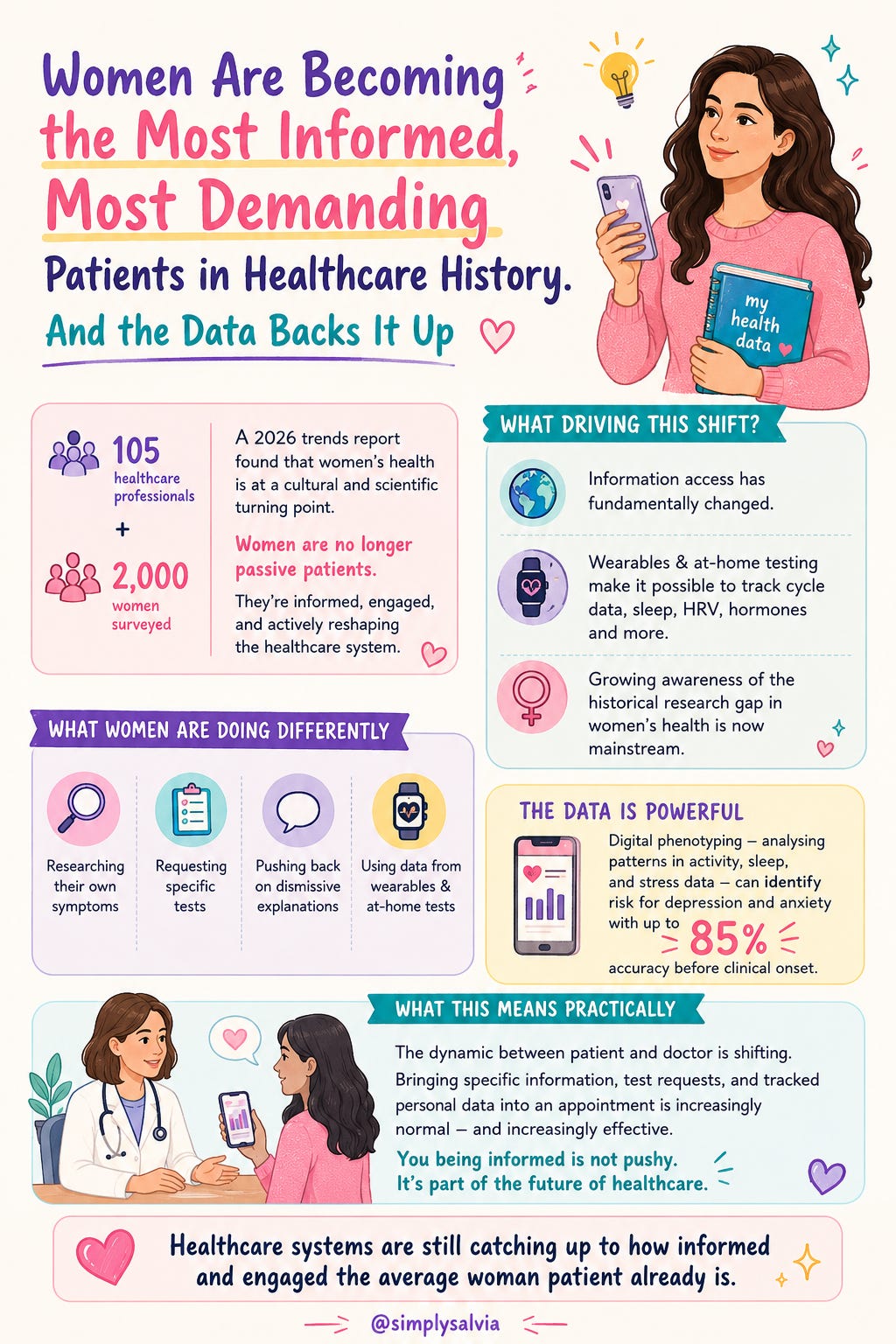
The report also points to digital phenotyping, analysing patterns in activity, sleep, and stress data as able to identify risk for depression and anxiety with up to 85% accuracy before clinical onset, suggesting that personal health data is moving from a passive tracking exercise into genuinely predictive territory.
What this means practically: the dynamic between patient and doctor is shifting, and bringing specific information, specific test requests, and tracked personal data into an appointment is increasingly normal and increasingly effective, not pushy or excessive. If anything, the research suggests healthcare systems are still catching up to how informed and engaged the average woman patient already is.
Women’s Brain Health Has Been a $250 Billion Research Gap. That’s Finally Starting to Close.
This is one of the more concrete signals of where research investment is heading, and it connects directly to several findings I’ve covered recently: the menopause and grey matter research, the ADHD and hormones research, the perimenopause cognitive symptom research.
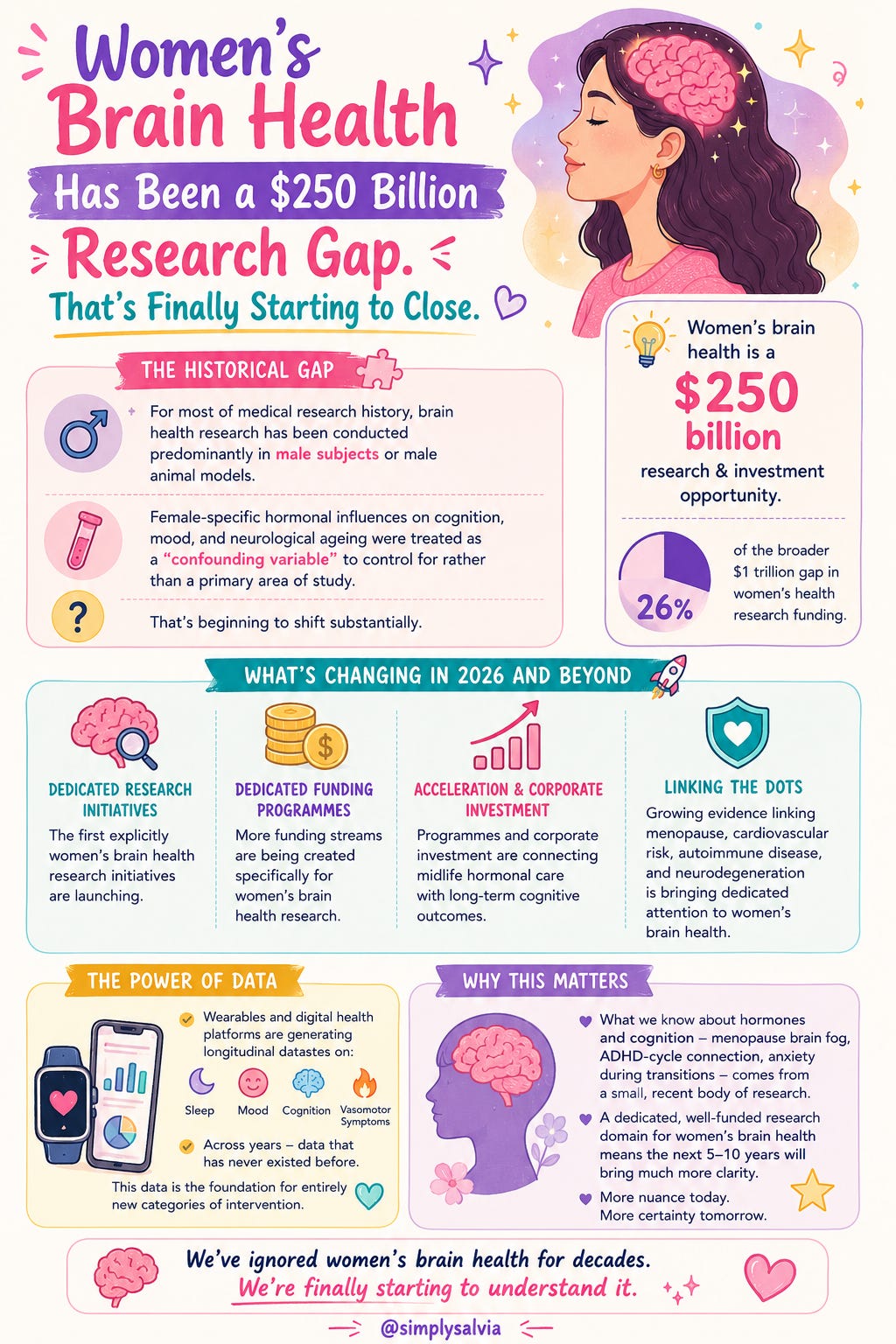
Women’s brain health is estimated as a $250 billion research and investment opportunity, representing 26% of the broader $1 trillion gap in women’s health research funding generally. For most of medical research history, brain health research has been conducted predominantly in male subjects or male animal models, with female-specific hormonal influences on cognition, mood, and neurological ageing treated as a confounding variable to control for rather than a primary area of study.
That’s beginning to shift substantially. 2026 is expected to bring the first explicitly women’s brain health research initiatives, dedicated funding programmes, acceleration programmes, and corporate investment specifically connecting midlife hormonal care with long-term cognitive outcomes. Growing evidence linking menopause, cardiovascular risk, autoimmune disease, and neurodegeneration is bringing dedicated attention back to women’s brain health as its own research domain, rather than a subset of general neurology.
Wearables and digital health platforms are expected to play a significant role here too, generating the longitudinal datasets on sleep, mood, cognition, and vasomotor symptoms across years that have simply never existed before, providing the foundation for entirely new categories of intervention that haven’t been possible without that data.
This matters because so much of what’s currently understood about hormones and cognition; the menopause brain fog, the ADHD-cycle connection, the anxiety that intensifies during hormonal transitions has been pieced together from a relatively small and recent body of research. A dedicated, well-funded research domain specifically for women’s brain health means the next five to ten years are likely to produce substantially more clarity on questions that currently still have more nuance than certainty.
Midlife Women’s Health Is Finally Being Treated as a Medical Priority, Not “Just Getting Older”
This connects to several threads I’ve covered; the HRT black box warning removal, the menopause and brain research but the bigger picture is worth naming directly, because it explains why so much menopause-related research has been surfacing recently.
International health leaders predict that by 2026, menopause will be treated as a serious medical and longevity inflection point, rather than merely a lifestyle inconvenience. Clinical organisations are expanding training programmes specifically to equip physicians with evidence-based menopause treatment strategies, including hormone therapy, broader symptom management, and long-term risk assessment, areas where, until recently, many GPs received minimal dedicated training.
The scale of the historical gap is significant. Menopause symptoms significantly disrupt daily functioning for most women who experience them, yet more than 80% never seek care, a statistic reflecting decades of under-recognition rather than a lack of need. Menopause is associated with systemic physiological changes affecting sleep, emotional stability, bone density, metabolism, and cardiovascular risk meaning the consequences of inadequate care during this transition extend well beyond the most commonly discussed symptoms like hot flushes.
For anyone in their 20s or early 30s reading this: this matters earlier than it might seem. The structural changes happening in research funding and clinical training now are shaping what kind of care will be available when you reach perimenopause and understanding that this transition is increasingly recognised as a major health inflection point, not a symptom set to quietly endure, is useful information well before you’re the one experiencing it. It’s also useful for advocating for mothers, aunts, and older colleagues navigating it right now within a system that’s still catching up.
Endometriosis Research Funding and Diagnostic Innovation Are Accelerating Together. Here’s Why That Combination Matters
This is a direct follow-up to the endometriosis research covered earlier this month, and the funding and innovation picture adds useful context to why the diagnostic landscape may finally be shifting after decades of stagnation.
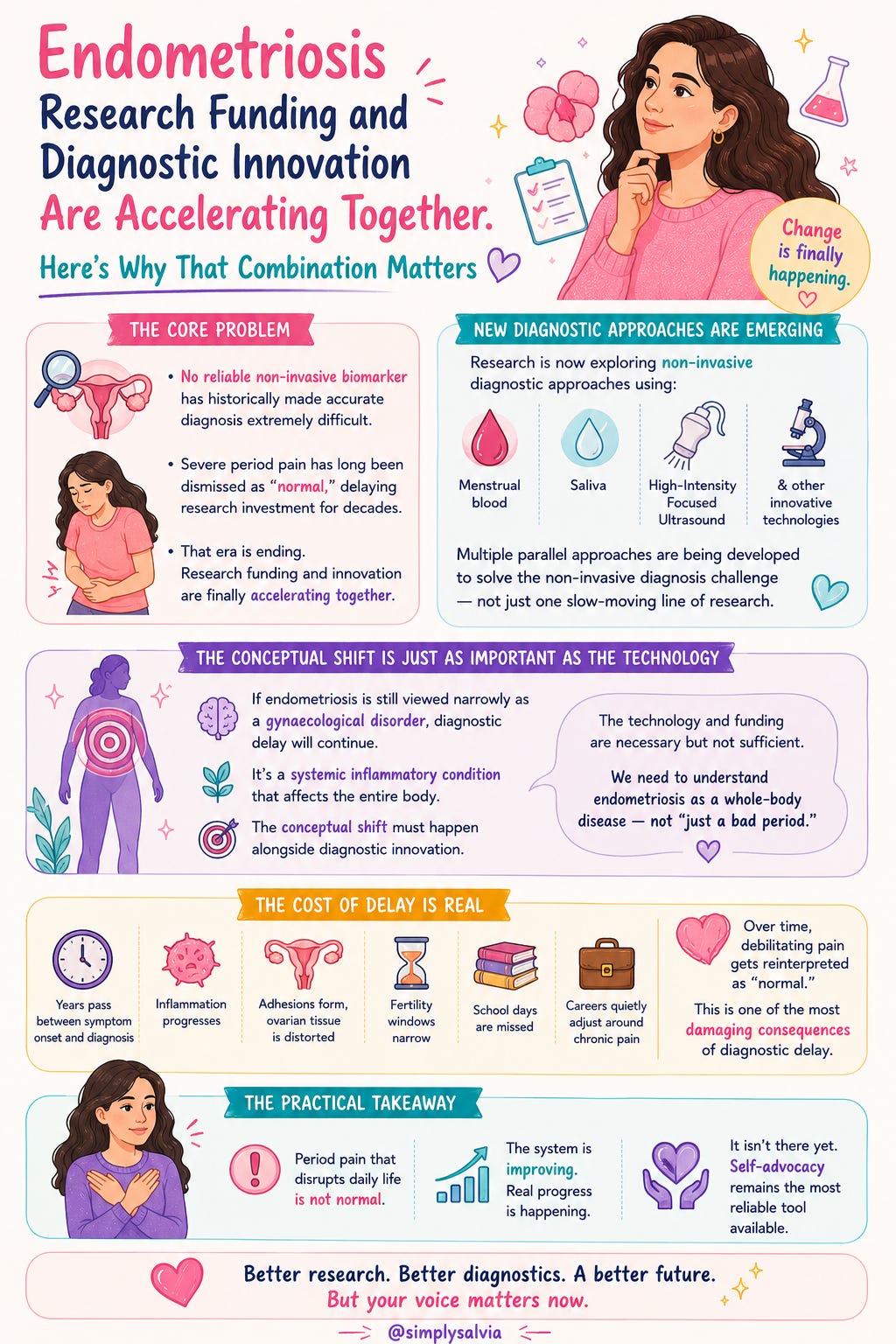
The core problem with endometriosis diagnosis has never really been a lack of medical interest in solving it, it’s been the combination of no reliable non-invasive biomarker and a historical tendency to treat severe period pain as a normal, if unfortunate, part of being a woman, which delayed research investment for decades. Research is now exploring new diagnostic approaches using menstrual blood, saliva, and technologies including High-Intensity Focused Ultrasound, multiple parallel approaches to solving the non-invasive diagnosis problem simultaneously, rather than the single, slow-moving research line that characterised previous decades.
STAT News coverage of new clinical guidance noted something important: if endometriosis continues to be understood narrowly as a gynaecological disorder rather than a systemic inflammatory condition with effects throughout the body, diagnostic delay will persist regardless of how good the new guidance or diagnostic tools become. In other words: the technology and the funding are necessary but not sufficient. The conceptual shift; treating endometriosis as a whole-body inflammatory disease rather than “a bad period” has to happen alongside the diagnostic innovation, or the new tools will simply confirm diagnoses years later than they should, rather than catching the condition early.
The same coverage made the cost of delay explicit: during the years between symptom onset and diagnosis, inflammation progresses, adhesions form, ovarian tissue is distorted, fertility windows narrow, school days are missed, and careers quietly adjust around pain that patients eventually begin to reinterpret as a normal part of their biology. That reinterpretation, coming to believe that debilitating pain is simply normal, is itself one of the most damaging consequences of prolonged diagnostic delay, because it teaches people to stop advocating for themselves.
The practical takeaway, again: period pain that disrupts daily function is not something to quietly absorb as normal while waiting for research and diagnostics to eventually catch up. The system is improving. It isn’t there yet. Self-advocacy in the meantime remains the most reliable tool available.
The information in this post is for educational and informational purposes only. None of the above constitutes medical advice. Always consult a qualified healthcare professional for personal health concerns.
Between Saturdays is a weekly research roundup from Simply Salvia. Four things from science and wellness worth knowing about. If someone sent this to you, you can subscribe here.
Detailed Readings
Mira’s health report: 6 trends reshaping 2026
Women's health: Predictions for 2026
In 2026, Women’s Health Research Will Finally Focus on Midlife