


Wellness culture tends to be very focused on the present moment. The current breakout, the current energy levels, the current supplement. This edition is about a slightly longer frame. Not in a scary way. In the “actually useful to know now” way. The decisions you make about muscle, bone density, and gut health in your 20s and early 30s are creating biological reserves that your future self is going to draw on. The research on that is clearer than most people realise. There’s also a finding about sunscreen application that’s almost universally relevant, and a reframe on rest that the productivity culture version of health has been getting wrong.
Caught My Eye…
Why Your 20s and 30s Are the Most Metabolically Important Decade of Your Life
This is not a scare story. It’s a reframe that the research supports and that almost no mainstream health content communicates properly.
Peak bone density is reached somewhere between the ages of 25 and 30. After that point, bone density can be maintained and protected, but it can’t be significantly increased. The bone density you build during your teens and twenties is what you’ll be drawing on for the rest of your life. Women who enter their 40s and 50s with higher bone density have a measurably lower risk of osteoporosis, fractures, and the cascade of health complications that follow, particularly after menopause, when estrogen decline accelerates bone loss.
Peak muscle mass follows a similar trajectory, peaking in the early 30s and declining gradually from around 35 onwards unless active resistance training maintains it. The Frontiers in Endocrinology January 2026 study I covered in the weight loss Short Dive confirmed that resistance training is the single most effective strategy for preserving lean muscle during a calorie deficit, but the same principle applies beyond dieting. Muscle built now is metabolic capital. It raises your resting metabolic rate, supports blood sugar regulation, protects joints, and is the most reliable predictor of independence and physical function in later life.
The 2026 women’s health trends report from Mira noted that women aged 25–30 are now the most active health trackers, and cited a growing research consensus that the habits built in your 20s and 30s become your biological reserves for your 50s and 60s. Muscle mass, bone density, cardiovascular fitness, metabolic health, gut microbiome diversity — all of these peak and plateau in early adulthood, and the maintenance trajectory from there depends heavily on the habits already in place.
What the practical version looks like: resistance training started in your 20s or early 30s is not just fitness. It’s bone and muscle maintenance that will matter more in 20 years than it does now. Adequate calcium and vitamin D during this same window supports the bone mineralisation that peaks before 30 and can’t be fully recaptured afterwards. The baseline tests worth considering in your 20s to early 30s: AMH (ovarian reserve, if fertility planning is relevant), a DEXA scan if bone density is a concern (family history, history of hormonal disruption or very low body weight), full metabolic and hormone panel, and vitamin D levels.
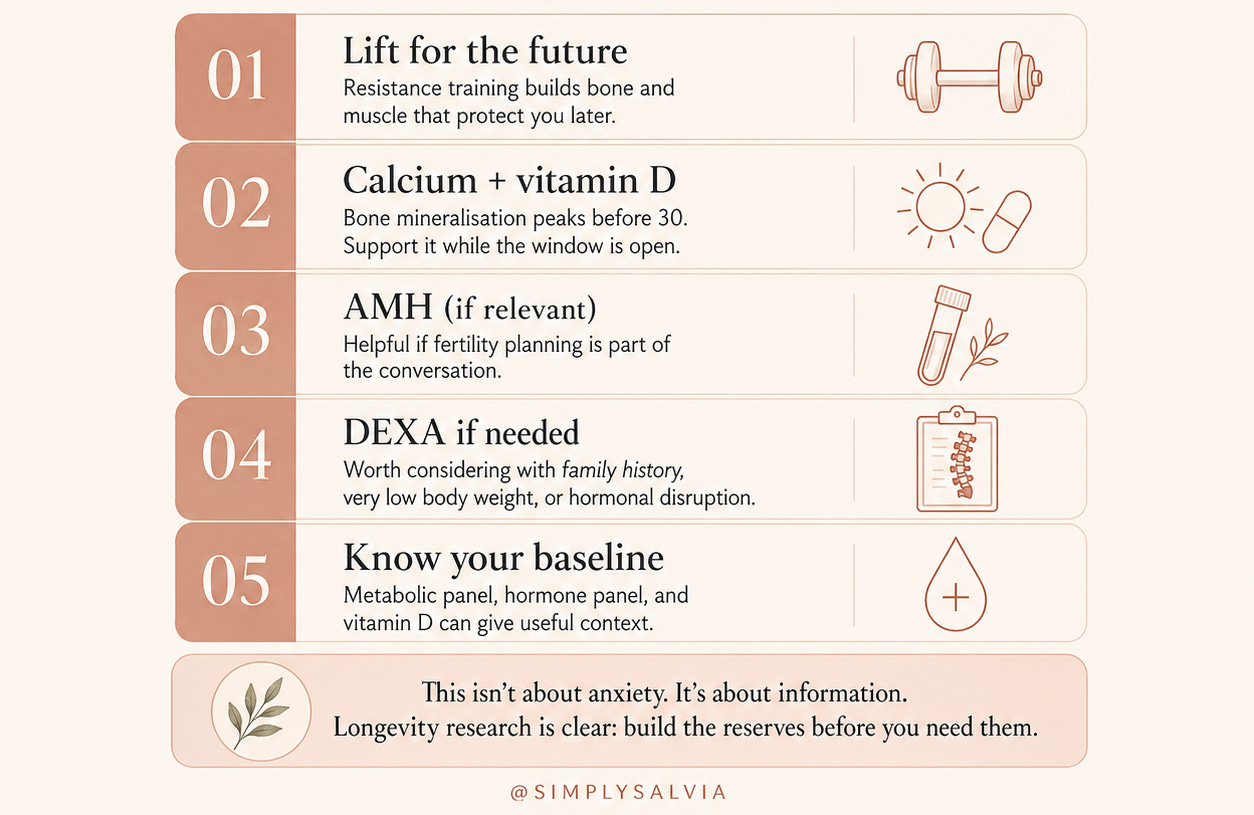
None of this is about anxiety. It’s about using information. The research on longevity is consistent on one point: the time to build the reserves is before you need them, not after.
You’re Probably Not Applying Enough Sunscreen. The Research on How Much Is More Specific Than You Think.
Most people who wear SPF daily are wearing significantly less than the amount the SPF rating was tested at. This is not a minor discrepancy. It changes the protection level in a meaningful way.
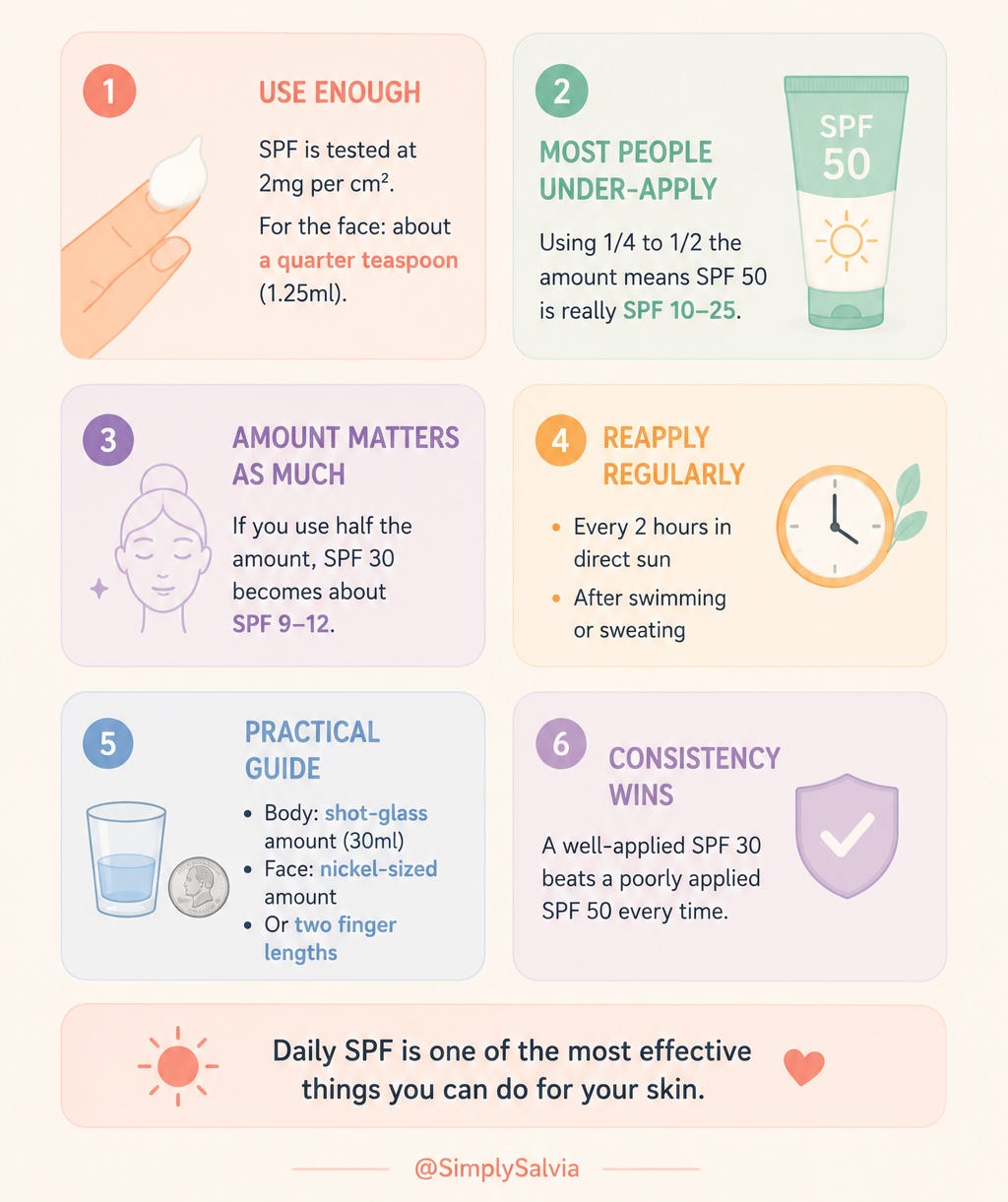
SPF ratings are calculated at a standard application density of 2mg per square centimetre of skin. For the face alone, this translates to approximately a quarter teaspoon (roughly 1.25ml) of SPF product. Research has consistently found that most people apply somewhere between a quarter and half of this amount in their actual daily routine, which means an SPF 50 product is effectively delivering somewhere between SPF 10 and SPF 25 in real-world conditions.
The implication is simple: if you’re wearing SPF 30 and applying about half the recommended amount, you’re getting approximately SPF 9–12. If your concern is photoageing (UV-driven collagen breakdown, hyperpigmentation, uneven texture) or skin cancer prevention, the application amount matters as much as the SPF number.
The practical guidance from dermatology research: a shot-glass amount (approximately 30ml) for the whole body when in a swimsuit. For the face, a nickel-sized amount, more than most people use. Two finger lengths of product from two fingers placed together (the “two-finger rule”) is a commonly cited estimate for face and neck combined.
Reapplication also matters more than most SPF content acknowledges. SPF degrades with UV exposure, sweating, and time. The standard guidance is reapplication every two hours in direct sun, or after swimming or heavy sweating. A morning application of SPF for a day spent mostly inside doesn’t require reapplication. A morning application for a day that includes extended outdoor time, a lunch break in the sun, or outdoor exercise does.
The SPF type matters less than application consistency and amount. A well-applied SPF 30 beats a poorly applied SPF 50 every time. The more important variables are: physical (mineral) or chemical filter based on your skin type and preference, broad-spectrum coverage (both UVA and UVB), and a texture you’ll actually use every day.
Rest Is Not the Opposite of Progress. The Research on Recovery Makes This Concrete.
The fitness and productivity culture version of health has a rest problem. Rest is framed as a necessary evil. The minimum required recovery before you can train again, the time when nothing useful is happening. The research says something different.
Here’s what is actually happening during rest and sleep after exercise:
The muscle tissue that was stressed during training is being repaired and reinforced by satellite cells (muscle stem cells). This process requires growth hormone, which, as the UC Berkeley research covered above shows, is primarily released during deep non-REM sleep. Without adequate sleep after training, the repair signal is dampened and the adaptation is incomplete.
Cortisol, the stress hormone that rises during intense training, is cleared during sleep. When the next training session happens before cortisol from the previous one has fully cleared, because recovery time was too short or sleep was too disrupted, cortisol accumulates. Chronically elevated cortisol promotes muscle breakdown (catabolism) rather than muscle building (anabolism), drives fat storage, and reduces the training adaptation you were working for.
Glycogen (the stored form of carbohydrate that powers high-intensity exercise) is replenished during rest, primarily through dietary carbohydrates eaten after exercise. Without adequate carbohydrates post-training and adequate rest time, glycogen stores remain depleted. The next training session starts at a lower energy substrate than the previous one. Performance declines, fatigue compounds, and the body starts pulling energy from muscle protein rather than stored fat, the opposite of what most training programmes are designed to produce.
The research on overtraining syndrome (the documented condition that occurs when training volume exceeds recovery capacity) finds that its primary symptoms are declining performance, persistent fatigue, disrupted sleep, elevated resting heart rate, and increased injury risk. These are the same symptoms that, in women, are also associated with low energy availability (not eating enough to support training volume) a well-documented condition in female athletes that suppresses the hormonal cycle and, in its more severe form, leads to bone stress injuries.
The practical version: rest days are not days when nothing is happening. They are days when the adaptation you trained for is actually occurring. The minimum effective dose of training for health and body composition is 2–3 resistance sessions per week. Adding more sessions without proportionally increasing recovery; sleep, nutrition, rest days does not produce proportionally better results. It produces overtraining.
For women specifically: in the late luteal phase, when sleep is already more fragmented and the nervous system is already more reactive, recovery from the same training stimulus takes longer. Protecting sleep, reducing evening training intensity, and not interpreting reduced capacity in this window as weakness are all evidence-informed responses to a documented physiological reality.
The Stress-Skin Feedback Loop, And the One Thing That Breaks It
I’ve covered the cortisol face content in the Short Dives. This is a specific addition to that picture that came from more recent research and is worth its own paragraph.
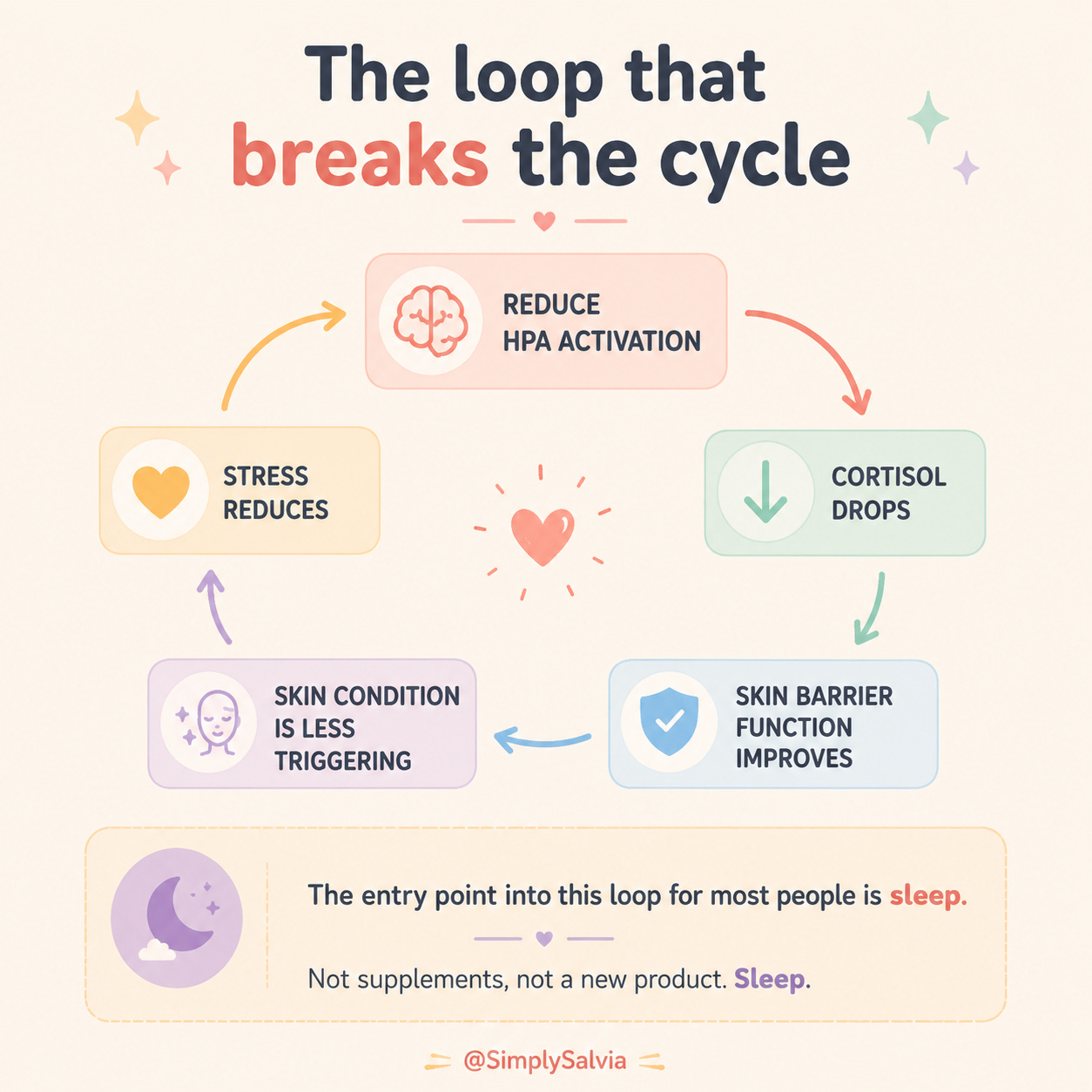
The relationship between stress and skin isn’t one-directional. Stress worsens skin through the cortisol mechanism; barrier disruption, increased sebum, impaired overnight repair. But skin conditions themselves then produce stress, which produces more cortisol, which worsens the skin condition further. Research has documented this bidirectional feedback loop in acne, eczema, and rosacea specifically, conditions where flares both cause and are caused by psychological stress, creating a cycle that’s genuinely difficult to break purely through topical intervention.
The finding that matters: a 2025 study specifically examining skin-related quality of life and stress found that psychological interventions, specifically cognitive behavioural therapy and mindfulness-based stress reduction produced measurable improvements in inflammatory skin conditions independent of topical treatment. This isn’t “your skin problem is in your head.” It’s that the HPA axis (the stress response system) is a direct regulator of skin inflammation, and interventions that reduce HPA activation produce skin improvements through that pathway.
The practical implication for anyone dealing with stress-driven skin: topical treatment matters and is worth doing properly. But if your skin consistently flares during high-stress periods and doesn’t fully respond to topical approaches, the HPA axis is likely a maintaining factor. Sleep, which is the most powerful cortisol regulator with the most evidence, is the intervention with the clearest mechanism for this specific pattern. Even single-night sleep deprivation measurably elevates cortisol and inflammatory markers and multiple consecutive nights of poor sleep drives the chronic cortisol elevation that makes stress-driven skin conditions persistent rather than episodic.
The information in this post is for educational and informational purposes only. None of the above constitutes medical advice. Always consult a qualified healthcare professional for personal health concerns.
Between Saturdays is a weekly research roundup from Simply Salvia. Four things from science and wellness worth knowing about. If someone sent this to you, you can subscribe here.
Detailed Readings:
Resistance training as a key strategy for high-quality weight loss in men and women
Mira’s Women Heath Trends Report: 6 Trends Reshaping 2026 and Beyond
How Much Sunscreen Are We Really Getting?
Why Does Sunscreen Only Last 2 Hours?
Scale-Free and Multifractal Time Dynamics of fMRI Signals during Rest and Task
Cortisol rises during intense workouts. Is that really a bad thing?
The Skin–Brain–Exposome Axis in Stress-Sensitive Dermatoses: A Narrative Review