


There’s a version of morning routine content that’s aspirational to the point of being useless: 5am wake-ups, cold plunges, hour-long workouts before most people’s alarms have gone off. This edition isn’t that. It’s about the actual biology of what happens in the first 90 minutes after you wake up, and four specific things the research says about how those 90 minutes set up the rest of your day. Some of them require a change in habits. Some of them just require understanding why the habits you already have might be working against you.
Caught My Eye…
Cortisol Peaks When You Wake Up. Your Phone Makes It Worse.
When you wake up, your body produces a surge of cortisol - your highest cortisol output of the entire day. This is called the Cortisol Awakening Response (CAR), and it’s intentional. Cortisol in the morning mobilises blood sugar, activates the immune system, sharpens focus, and prepares you physiologically for the demands of the day. It is the biological equivalent of your body booting up.
This morning cortisol peak is important and healthy. The problem is what happens when you immediately amplify it before your nervous system has had time to regulate it.
Checking your phone within the first few minutes of waking floods your brain with social comparison, unresolved notifications, stressful news, and dopamine-seeking behaviour before your prefrontal cortex (the part of the brain responsible for rational decision-making and emotional regulation) has fully come online. It typically takes 15–30 minutes after waking for the prefrontal cortex to reach full functional capacity. Stimulating the amygdala (the threat and reward detection centre) with a phone screen before that window closes means starting the day in a reactive, slightly elevated-stress state that carries forward.
A 2024 study on morning digital media use found that checking phones within 10 minutes of waking was associated with higher reported stress and more fragmented attention for the remainder of the morning. The mechanism isn’t complicated: cortisol is already at its peak, the nervous system is in a sensitised state, and the phone is an effective cortisol amplifier.
The 30-minute phone-free window after waking isn’t a productivity hack. It’s giving the nervous system the time it needs to land from sleep before being asked to process stimulation. Morning light exposure in that same window, ideally outdoor if possible, has the strongest evidence for anchoring the circadian rhythm, supporting serotonin synthesis, and improving mood and focus for the hours that follow.
The Breakfast Research Has Been Saying This For Years. Most People Are Still Not Doing It.
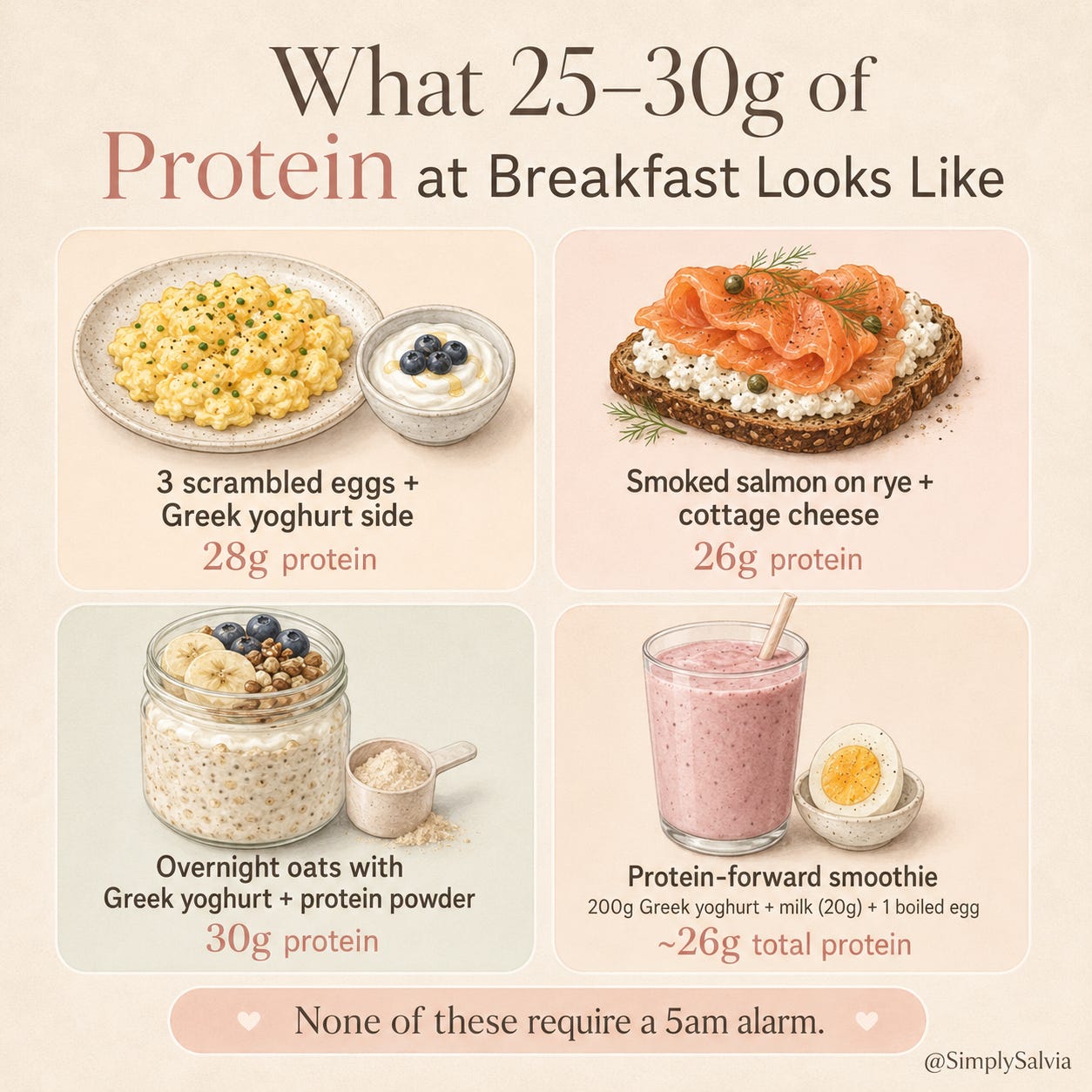
The most consistent finding in breakfast nutrition research for women is so simple it sounds like it can’t be right: eating 25–30g of protein at breakfast produces better blood sugar control, reduces hunger and cravings for hours, and has measurable effects on what you eat for the rest of the day.
A University of Missouri study found that when women consumed high-protein breakfasts, they maintained significantly better glucose and insulin control than they did with lower-protein or no-protein meals, and the benefit extended beyond breakfast, with improved blood sugar control even after lunch. Research on premenopausal women found that increasing protein at breakfast to 30g reduced daily caloric intake by an average of 441 calories over 12 weeks and produced significant weight loss without any instruction to eat less. Just more protein at breakfast.
The mechanism: protein at breakfast triggers GLP-1 and PYY; the satiety hormones that signal fullness to the brain. These hormones take 15–20 minutes to reach the brain after eating, which is why eating quickly defeats the system. Protein stimulates these hormones more powerfully than carbohydrates or fat. It also stabilises blood sugar in a way that carbohydrate-heavy breakfasts (cereal, toast, pastry, fruit juice) don’t. Setting up stable energy for the morning rather than the blood sugar spike-and-crash that drives the 10am hunger and the need for caffeine to push through it.
The typical British and American breakfast is optimised for the opposite of this: fast, convenient, carbohydrate-heavy, low protein. A bowl of cereal and orange juice starts the day with a blood sugar spike before 8am and a crash by 10am. The tiredness, the craving, the difficulty concentrating mid-morning all of these are very often blood sugar consequences of the first meal, not signs that you need more coffee.
Why You Should Wait 90 Minutes Before Your First Coffee
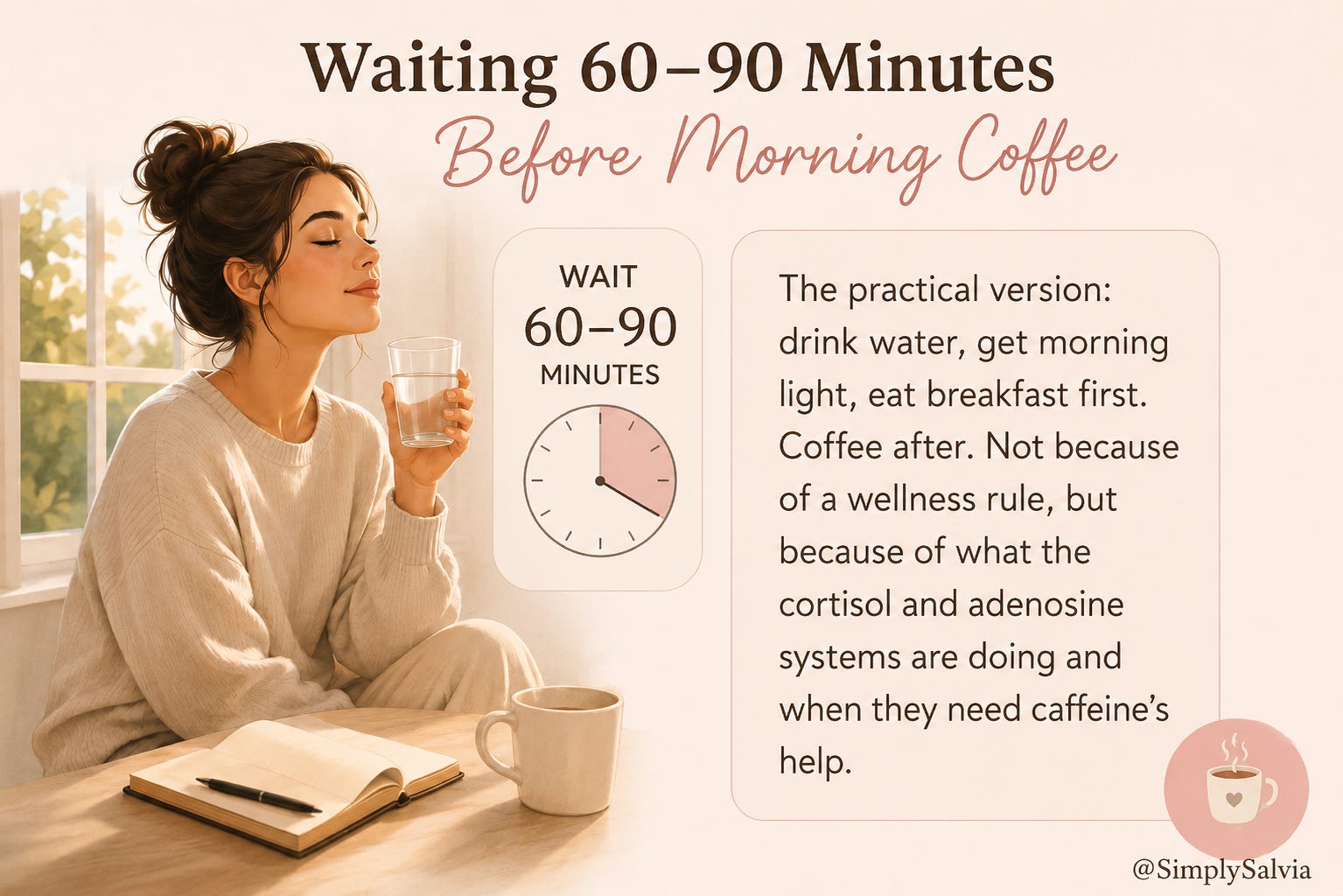
Caffeine works by blocking adenosine receptors. Adenosine is the compound that accumulates in your brain while you’re awake and produces sleepiness -it’s the biological pressure that builds throughout the day and makes you tired by evening. Caffeine doesn’t remove adenosine. It sits in adenosine’s receptor seats, blocking the signal. When the caffeine clears (after 5–7 hours) the adenosine that accumulated while you were drinking coffee floods back in all at once, often producing the afternoon crash that prompts another coffee.
Here’s the part most people don’t know: adenosine levels are actually at their lowest when you wake up, because sleep cleared most of the previous day’s accumulation. For the first 60–90 minutes after waking, your cortisol peak is handling the alertness that caffeine would normally provide. Drinking coffee in this window isn’t giving your brain something it needs, it’s adding caffeine to a system that’s already running on its own alertness mechanism.
Neuroscientist Dr. Andrew Huberman’s popularisation of the “wait 90 minutes for coffee” protocol has research backing, even if the specific 90-minute number isn’t from a single definitive study. The evidence behind it: cortisol suppresses caffeine’s effectiveness (they both compete for similar arousal pathways), so caffeine consumed during the cortisol peak provides less benefit than caffeine consumed after it. Waiting until cortisol has begun its natural post-peak decline( typically 60–90 minutes after waking) means the caffeine is doing more useful work and the afternoon crash is less severe.
This doesn’t mean no coffee before 90 minutes will ever work. Caffeine still blocks adenosine receptors regardless of timing. But the effectiveness, the dependency curve, and the afternoon crash are all affected by when in the morning you drink it.
Skipping Breakfast Has Different Effects in Women Than Most Research Suggests
Intermittent fasting and time-restricted eating have strong evidence for metabolic health particularly in overweight and metabolically compromised populations. The 16:8 protocol (eating within an 8-hour window, fasting for 16 hours) has consistent research support for blood sugar regulation and weight management.
But there’s a sex-specific dimension that most of the content on intermittent fasting completely ignores. Most of the foundational IF research was conducted in men. Women’s hormonal systems, specifically the hypothalamic-pituitary-ovarian (HPO) axis that governs the menstrual cycle are more sensitive to caloric restriction and meal timing than men’s.
A 2025 review of time-restricted eating in overweight women found meaningful metabolic benefits but also flagged that aggressive fasting windows (over 16 hours) can activate the same stress responses in the HPO axis that underlie hypothalamic amenorrhoea (period loss in response to energy restriction). Cortisol rises with prolonged fasting. Elevated cortisol suppresses GnRH, the hormone that controls the reproductive cycle. In women who are already hormonally sensitive; those with irregular cycles, high stress levels, low body weight, or a history of disordered eating, extended fasting windows can disrupt the cycle.
Research on women specifically found that those who skip breakfast consistently show higher levels of cortisol and more menstrual irregularity than those who eat breakfast. The mechanism: overnight is already a prolonged fasting period, and extending it through skipping breakfast means the body is in a cortisol-driven fasting state well into the morning. For women whose hormonal health is stable and who aren’t showing any cycle disruption, moderate time-restricted eating (12–14 hour windows rather than 16+) appears metabolically beneficial with minimal hormonal risk. For women with irregular cycles, high stress, or hormonal sensitivity, skipping breakfast may not be the right intervention, regardless of its general evidence base.
This isn’t “intermittent fasting is bad for women.” It’s “the research was built on male participants and the female-specific data adds complexity that most fasting content doesn’t acknowledge.”
The information in this post is for educational and informational purposes only. None of the above constitutes medical advice. Always consult a qualified healthcare professional for personal health concerns.
Between Saturdays is a weekly research roundup from Simply Salvia. Four things from science and wellness worth knowing about. If someone sent this to you, you can subscribe here.
Detailed Readings
Morning Light Exposure Affects Cortisol Levels and Stress Response
Protein-packed breakfast prevents body fat gain in overweight teens
Understanding Cortisol Hypothalamic Amenorrhea: The Science of Stress