


This edition is the smaller-scale one. Four findings that didn’t make major headlines. Attention and focus, and a newly discovered brain circuit that might explain why some strategies work better than others. The protein timing research that adds a specific nuance to what we covered in the weight loss short dive. A finding about sleep and cancer risk that’s worth knowing without being alarmist about. And a finding about social media and body image that’s more specific and more actionable than the general conversation tends to be.
Caught My Eye…
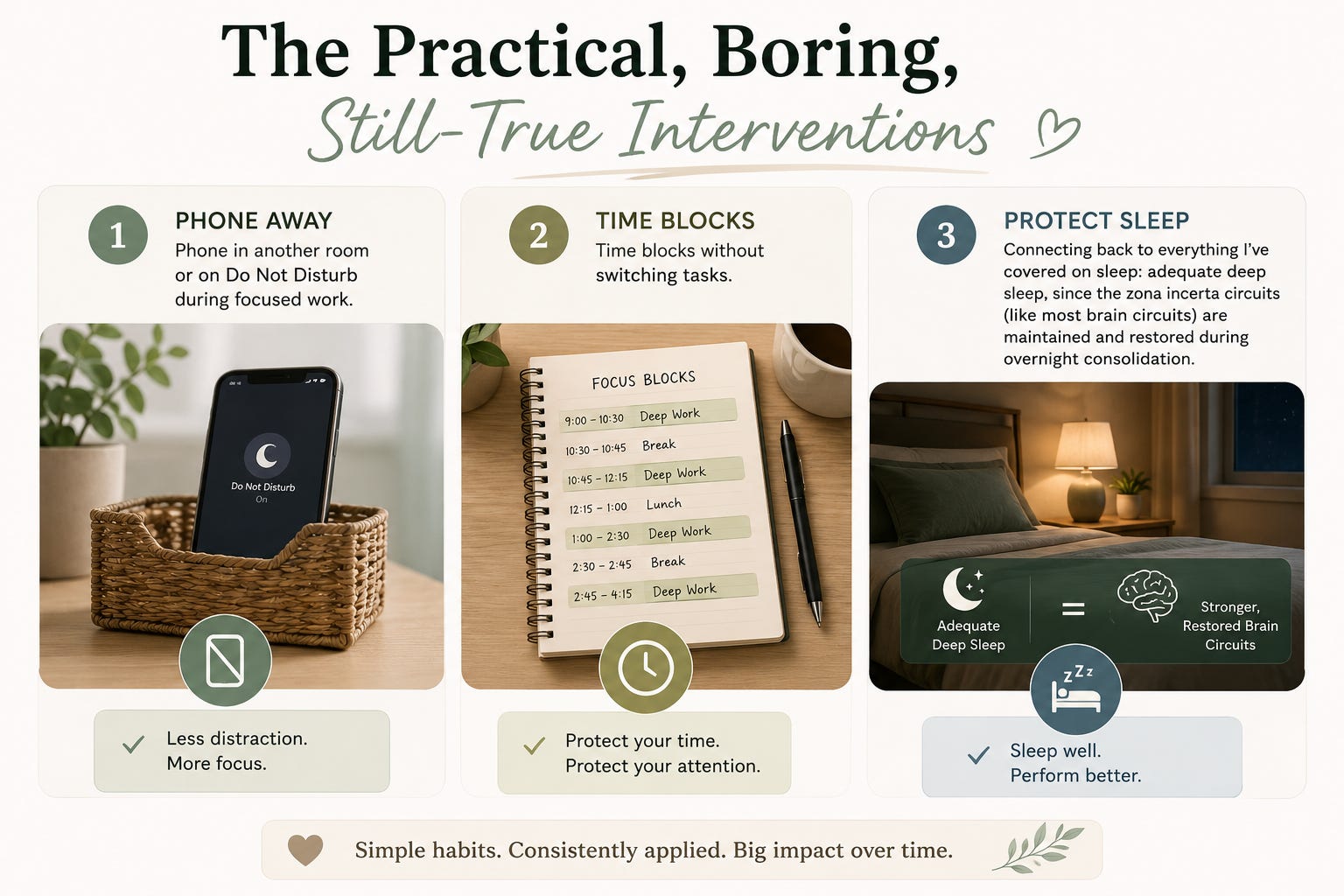
Scientists Just Found the Brain’s Built-In Focus Filter And What Interferes With It
Most conversation about focus and attention in the wellness space ends up at the same place: reduce screen time, try meditation, maybe try magnesium. That advice isn’t wrong, but it lacks a mechanism. A finding published in June 2026 provides one.
The neurons identified are located in a region called the zona incerta, a small area in the brainstem that’s evolutionarily ancient, present across many mammalian species. This cluster acts as a gating mechanism for attention: when activated, it helps the brain filter out irrelevant sensory information and sustain focus on a task. When it’s underactive or disrupted, attention becomes more fragmented and the brain is more easily pulled toward new stimuli.
What’s interesting about this from a women’s health perspective: the zona incerta has connections to several hormonal and stress-regulatory systems, including pathways that interact with estrogen and cortisol. This is consistent with the well-documented experience that attention and focus fluctuate across the menstrual cycle, particularly in the late luteal phase when estrogen is falling and cortisol sensitivity is higher. The neurological basis for those fluctuations is still being mapped, but this finding suggests the attention-gating system is more intertwined with the hormonal environment than the “just work harder” framing of focus difficulties implies.
The finding also has implications for understanding why constant notification environments are so cognitively costly. Every notification is a competing input that the focus-filter circuit has to evaluate. In an environment of high-frequency, high-novelty stimuli, the filter is never given the uninterrupted window it needs to sustain deep focus, which is less about willpower and more about the mechanics of how this circuit operates.
Protein Timing Matters More Than Most Nutrition Content Acknowledges
This builds directly on the protein breakfast research covered in a previous post and the weight loss short dive, but with a new piece that adds specificity.
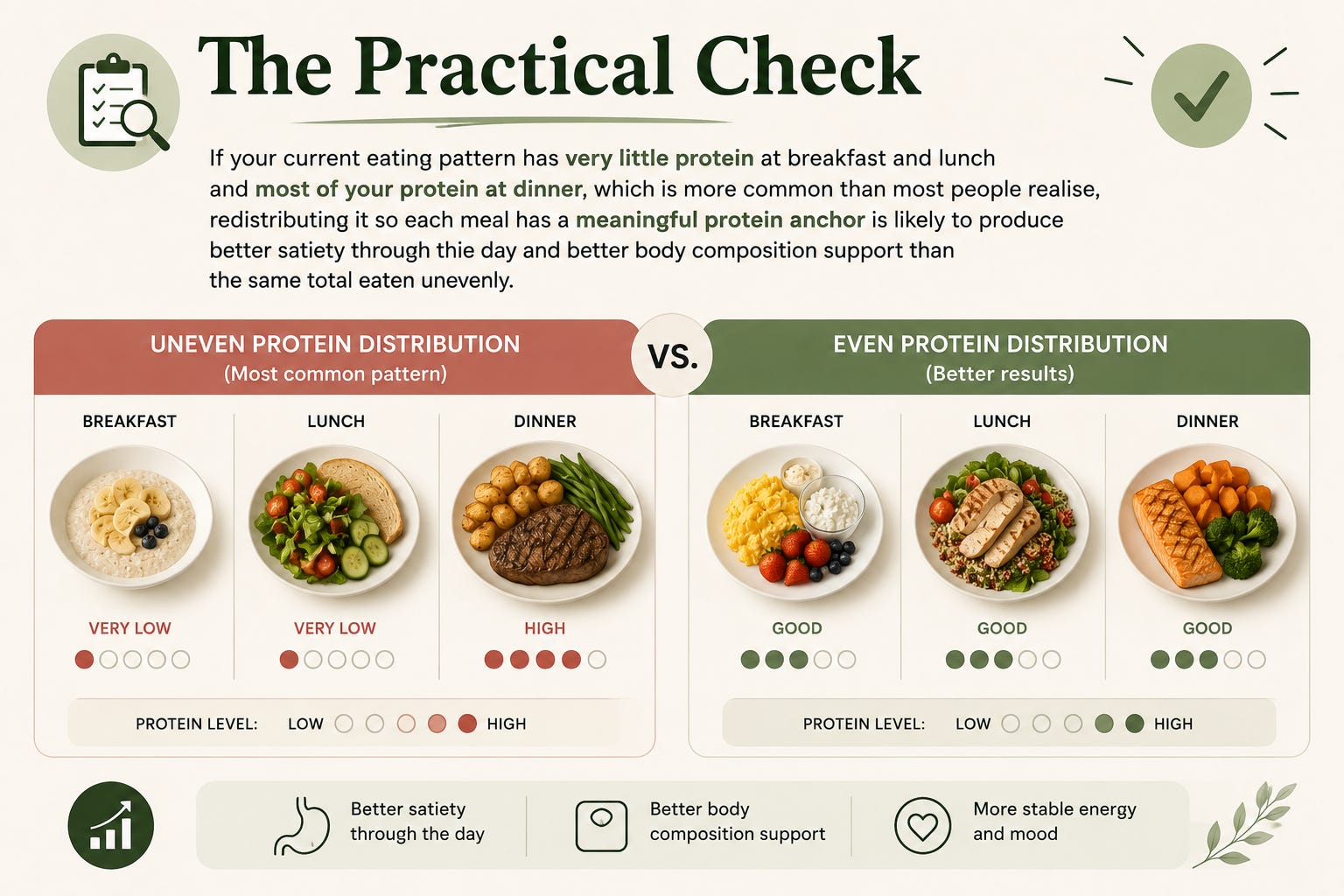
The protein-for-satiety story has been well-established: protein is the most satiating macronutrient, it triggers the strongest GLP-1 and PYY response, it preserves muscle during a calorie deficit, and it has the highest thermic effect. All of that holds. What’s been getting more research attention recently is whether when you eat protein across the day affects outcomes beyond total daily intake.
The emerging picture from 2025–2026 research: protein’s satiety effects are most powerful when it’s distributed across all meals rather than concentrated in one sitting. This matters because a common pattern, particularly in women following dietary restriction is to eat very little protein through the morning and early afternoon, then consume the majority at dinner. Research on protein distribution suggests this pattern underutilises protein’s appetite-suppressing and muscle-building effects compared to an even distribution of 25–30g across three meals.
There’s a muscle synthesis angle to this too: muscle protein synthesis (the process by which dietary protein is incorporated into muscle tissue) appears to be more efficient when protein is consumed at regular intervals throughout the day rather than in one large dose. The muscle-building machinery seems to reach a saturation point with single large protein doses, meaning that 90g at one meal is less effective than 30g at three meals for the same protein total.
Sleep Duration, Deep Sleep, and Cancer Risk. What the Research Says Without the Alarm
This one needs to be framed carefully, because the headline version of it ; “poor sleep causes cancer” is both an oversimplification and, in that form, more anxiety-inducing than informative. Here’s what the research actually says.
Chronic sleep disruption specifically, consistently sleeping fewer than 6 hours per night, or having severely fragmented sleep for extended periods is associated in observational studies with elevated risk of several cancers, including breast cancer. The proposed mechanism involves melatonin: melatonin is produced during darkness and suppresses the proliferation of certain cancer cells, including oestrogen receptor-positive breast cancer cells. Chronic light exposure at night and severely disrupted sleep reduce melatonin production, removing this suppressive effect.
A July 2026 research finding added a specific cellular mechanism: researchers identified a previously overlooked mechanism of brain cell death that appears to play a major role in Alzheimer’s disease and frontotemporal dementia but in doing so, also illuminated the deep sleep clearing processes (the glymphatic system, which clears cellular waste overnight) that are relevant to a broader set of conditions when chronically disrupted.
Two things are worth being clear about: the observational associations between sleep and cancer risk are real but modest in most studies, and they don’t establish causation. People who chronically sleep fewer than 6 hours often have other health and lifestyle factors that independently elevate risk. And the mechanism: melatonin suppression of cancer cell proliferation is one pathway among many.
What the research does consistently support, without overstating it: maintaining regular sleep hours, keeping the sleeping environment dark (blocking artificial light), and prioritising 7–8 hours of uninterrupted sleep are all independently supported interventions with the best evidence for multiple health outcomes simultaneously. The cancer risk dimension adds an additional layer to what is already a comprehensive case for sleep as a foundational health behaviour, not a reason for alarm, but a reason to take the priority of sleep seriously in a culture that routinely treats it as optional.
The Social Media and Body Image Research Is Getting More Specific and More Useful
The “social media is bad for body image” finding has been replicated so many times it has almost stopped being news. What’s becoming more useful in the 2025–2026 research is the specificity, which types of social media use, which types of content, and which individuals are most affected, in ways that allow more targeted and actionable guidance than “use social media less.”
What the recent research has been finding:
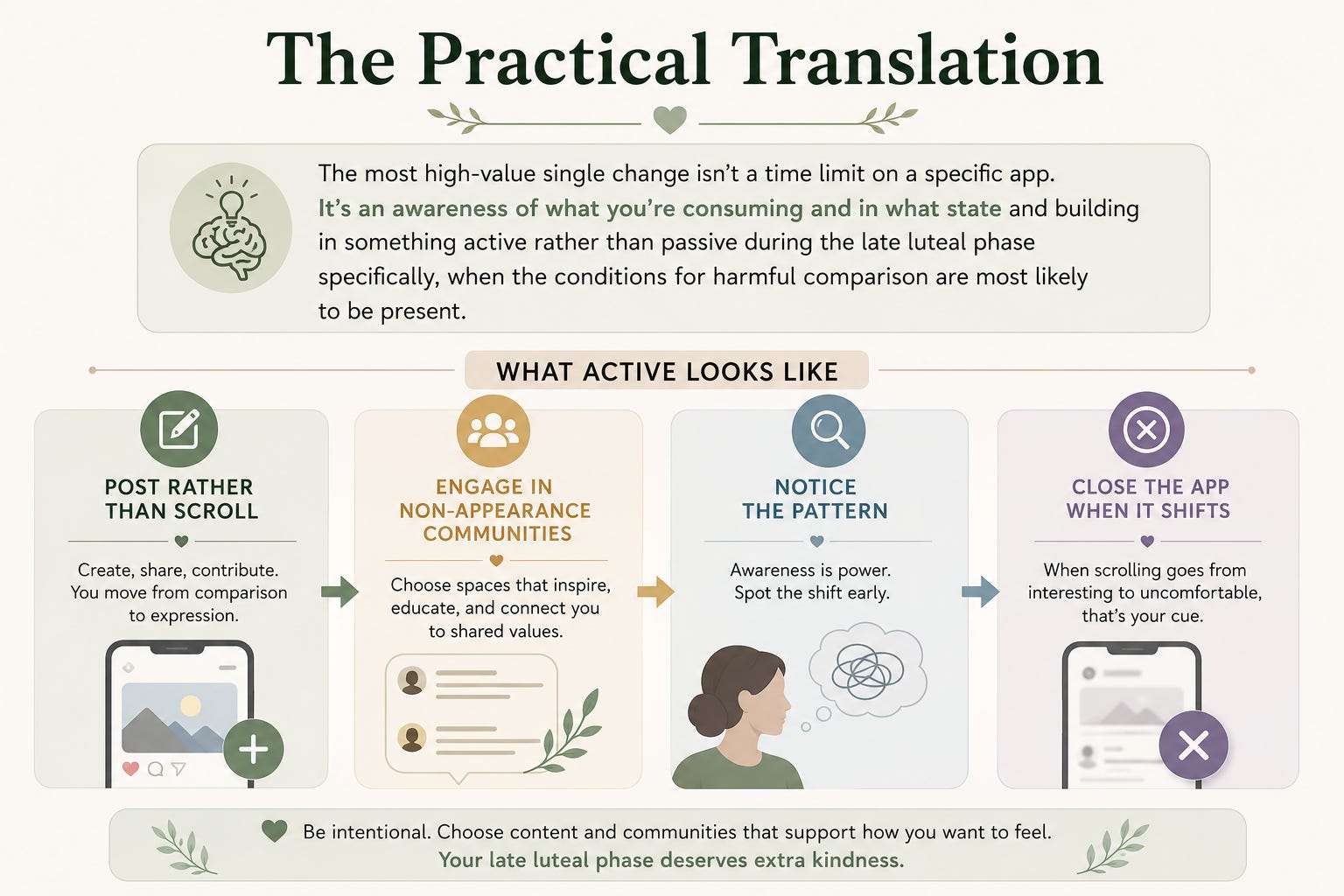
Passive consumption: scrolling without interaction, comparing without engaging, produces significantly worse body image outcomes than active engagement (posting, commenting, creating). This distinction matters because the guidance “use social media less” ignores that some forms of use are considerably more harmful than others. Passive scrolling through appearance-focused content in a low-mood state is the highest-risk pattern. Creating content, engaging in communities, and active participation carry much smaller (and in some cases positive) associations.
The specific content type matters more than the platform. Appearance-focused content: transformation posts, before/afters, body-focused lifestyle content, consistently produces worse body image outcomes regardless of whether it’s Instagram, TikTok, or elsewhere. Non-appearance content on the same platforms — skill-based, interest-based, educational, doesn’t produce the same effects.
For women, the luteal phase specifically is the highest-risk window for appearance-based comparison. Estrogen falling in the late luteal phase is associated with lower mood, lower self-esteem, and higher susceptibility to social comparison. This isn’t widely acknowledged in either the mental health or the social media research, but the mechanism; reduced serotonin support reducing mood stability in a phase when body image is already hormonally more fragile is consistent with everything we know about how estrogen and serotonin interact.
The information in this post is for educational and informational purposes only. None of the above constitutes medical advice. Always consult a qualified healthcare professional for personal health concerns.
Between Saturdays is a weekly research roundup from Simply Salvia. Four things from science and wellness worth knowing about. If someone sent this to you, you can subscribe here.
Detailed Readings
Scientists discover ancient neurons that control attention
Dietary Protein Distribution Positively Influences 24-h Muscle Protein Synthesis in Healthy Adults
Alzheimer’s breakthrough: Scientists restore two hours of sleep without clearing brain plaques