


Snacking has a bad reputation but maybe it deserves a better one. In nutrition research, some of the most fascinating findings in recent years haven’t come from restrictive diets, but from substitutions: swapping what we reach for between meals.
This week’s four studies explore how modest changes such as replacing chips or cookies with almonds, walnuts, cashews, or even pine nut oil affected blood lipids, vascular function, and appetite regulation. The message is refreshingly practical: what matters isn’t snacking itself, but what you snack on.
Caught My Eye…
Almonds and Arterial Health
In the ATTIS Trial, published in the American Journal of Clinical Nutrition (2020), researchers followed adults aged 30–70 who were at moderate cardiovascular risk. For six weeks, participants replaced about 20% of their daily calories with either whole roasted almonds (roughly 1.5–2 ounces a day) or a calorie-matched control snack that contained no nuts.
After six weeks, the almond group showed a 3.6% improvement in endothelial function—that’s a direct measure of how well blood vessels relax and expand, which predicts long-term heart health. They also had a drop in LDL cholesterol of about 0.25 mmol/L (roughly 10 mg/dL). Importantly, liver fat and body weight stayed the same, which means these benefits weren’t driven by weight loss or calorie restriction.
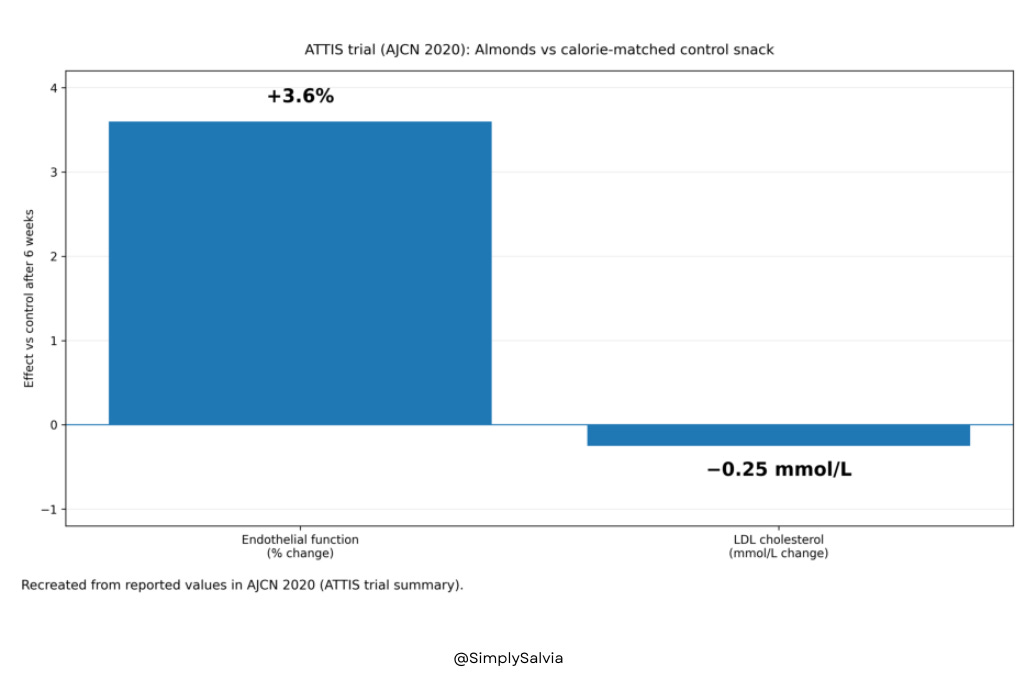
The researchers suggest almonds’ mix of unsaturated fats, vitamin E, magnesium, and plant polyphenols improved how arteries respond to blood flow. In short, a handful of almonds a day helped blood vessels behave like those of someone younger and metabolically healthier.
Walnuts and Healthy Aging
The Walnuts and Healthy Aging (WAHA) Trial, published in Circulation (2021), ran for two full years across research centers in Barcelona and California. Over 700 older adults were randomly assigned either a walnut-free diet or one in which walnuts made up about 15% of daily calories, roughly 30–60 grams (½ cup) per day.
After two years, those eating walnuts had a modest but consistent reduction in LDL cholesterol (around 4.3 mg/dL, or 3.6%) and a healthier shift in lipoprotein particle patterns, meaning fewer small, dense LDL particles that contribute to plaque buildup. These improvements appeared stronger in men, but beneficial trends were seen across the group. Weight remained stable throughout the study with no evidence that daily nuts led to weight gain.
The researchers concluded that walnuts’ unique nutrient profile, rich in omega 3 ALA, polyphenols, and fiber helps stabilize lipid metabolism and dampen chronic vascular inflammation. In essence, walnuts act as gentle cardiovascular “maintenance,” especially valuable as we age.
Cashews and Cholesterol
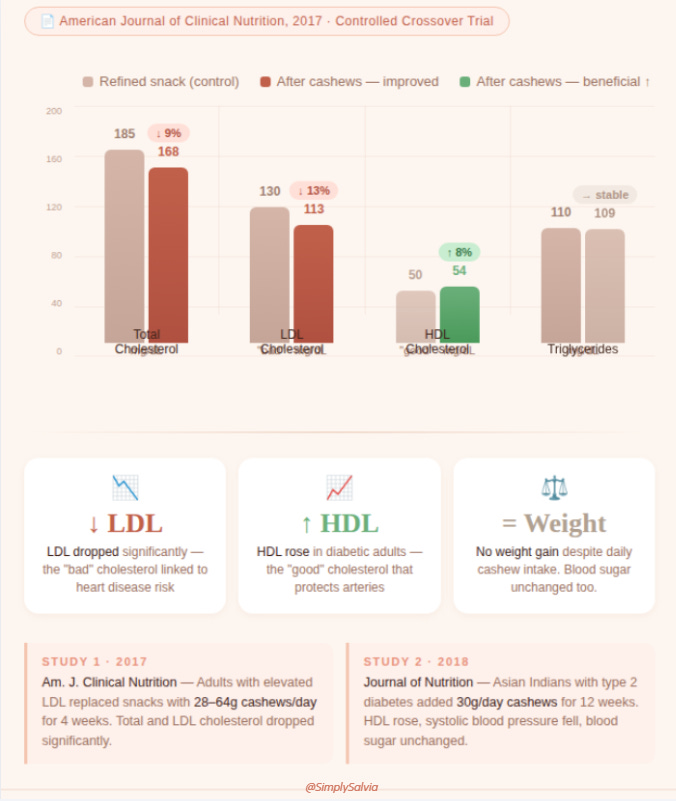
Cashews might seem indulgent, but research shows they’re surprisingly heart-friendly. A 2017 controlled-feeding crossover trial in the American Journal of Clinical Nutrition asked adults with elevated LDL cholesterol to replace their usual snacks with cashews (28–64 g/day) for four weeks, then switch back to a control snack such as potato chips.
During the cashew phase, participants’ total and LDL cholesterol dropped significantly, while HDL (“good”) cholesterol and triglycerides stayed the same. This suggests that cashew fats mostly monounsaturated improve lipid balance without raising triglycerides.
A follow-up 12-week trial in Asian Indians with type 2 diabetes (Journal of Nutrition, 2018) found that adding about 30 g/day of cashews raised HDL cholesterol and lowered systolic blood pressure, all without changes in blood sugar or body weight.
Both studies emphasize the same principle: when we replace refined carbs with nutrient dense plant fats, lipid quality improves. Cashews don’t just add calories; they subtly shift the metabolic environment in favor of cardiovascular health.
Pine Nut Oil and Appetite Signaling — Hormones that Listen to Food
The Clinical Nutrition (2021) study on hydrolyzed pine nut oil (rich in pinolenic acid) explored how specific plant oils influence hunger hormones. In this crossover trial, healthy adults received either pine nut oil or a control oil, both delivered in capsules that released in the small intestine.
Researchers tracked glucose, insulin, and appetite hormones like GLP-1 (which promotes fullness) and ghrelin (which stimulates hunger). Compared with control, pine nut oil boosted GLP-1 levels, suppressed ghrelin later after meals, and made participants feel fuller for longer, without changing total calorie intake.
This study didn’t focus on weight loss it looked upstream, at hormonal satiety signaling. By stimulating intestinal receptors that regulate appetite, pine nut oil may help curb overeating naturally, without forcing dietary restraint.
Nutrition science often feels like it’s about restriction. These studies remind us it can also be about replacement, about adding better fats, fibers, and plant compounds instead of removing joy from food.
In each of these trials, a small, realistic change produced measurable health gains: almonds improved blood flow, walnuts fine tuned cholesterol, cashews lowered blood pressure, and pine nut oil calmed appetite hormones. None required weight loss, supplements, or elaborate diets, just better choices made consistently.
Detailed Readings
Snacking on almonds for six weeks