

Seed oils sit at the center of one of the loudest nutrition debates online: “heart-healthy” staple or inflammatory villain. Strong feelings rarely map cleanly onto evidence, so the only honest way through is to separate clinical outcomes from biomarkers, and diet context from oil chemistry. Four papers; two recovered randomized trials and two mechanistic studies offer a clearer picture. Certainty stays limited, yet patterns emerge: lowering LDL does not automatically guarantee better outcomes, linoleic acid can form bioactive oxidation products, and overheating PUFA-rich oils changes what ends up in the pan (and the air).
Caught My Eye…
Sydney Diet Heart Study
The Sydney Diet Heart Study was a randomized trial from the late 1960s that followed men who had already experienced a heart attack. Researchers asked one group to replace saturated fats with safflower oil and safflower oil margarine, both very high in omega-6 linoleic acid while the control group continued their usual diet.
When the original trial was reanalyzed decades later using recovered data, an unexpected pattern emerged. Although cholesterol levels fell in the safflower-oil group, those participants experienced higher rates of death from coronary heart disease and cardiovascular causes compared with controls.
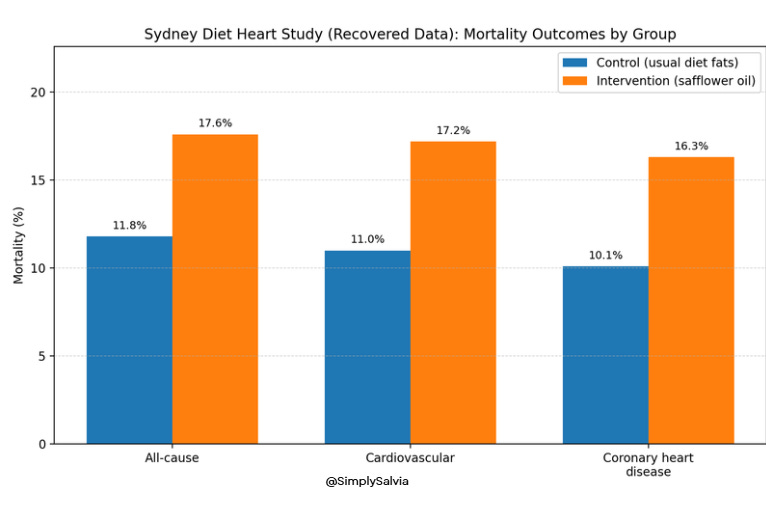
The study did not test mechanisms directly, but the authors discussed possible explanations related to how high linoleic acid intake may oxidize and form biologically active lipid byproducts. Importantly, this was a specific population (men with existing heart disease) eating a specific oil in a very different food environment than today. Still, the findings challenged the assumption that lowering cholesterol alone guarantees better heart outcomes.
Minnesota Coronary Experiment
The Minnesota Coronary Experiment was a large randomized trial conducted between 1968 and 1973 in hospitals and nursing homes. Participants were assigned either a traditional diet high in saturated fat or a diet where saturated fats were replaced with vegetable oils rich in omega-6 linoleic acid.
When previously unpublished data from the trial were recovered and analyzed decades later, researchers found that while the vegetable-oil diet successfully lowered cholesterol, this reduction did not translate into clear improvements in survival. In some subgroups, particularly older adults, lower cholesterol was paradoxically associated with higher mortality.
The study didn’t conclude that vegetable oils were harmful outright. Instead, it highlighted a critical gap: biochemical improvement (lower cholesterol) does not automatically guarantee better clinical outcomes. The findings raised important questions about whether all methods of lowering cholesterol are equally beneficial especially when achieved through very high linoleic acid intake.
Lower Linoleic Acid Intake Reduced Oxidized Lipid Byproducts in Humans
To explore possible biological pathways behind these older trial results, researchers later conducted a controlled human dietary intervention focused on linoleic acid metabolism. Participants followed a diet designed to lower linoleic acid intake, and investigators measured circulating levels of oxidized linoleic-acid metabolites (known as OXLAMs).
The results were straightforward: reducing dietary linoleic acid led to significantly lower levels of these oxidized lipid byproducts in the bloodstream. These compounds are known to form when linoleic acid undergoes enzymatic or free-radical oxidation and are discussed in the broader literature as biologically active molecules.
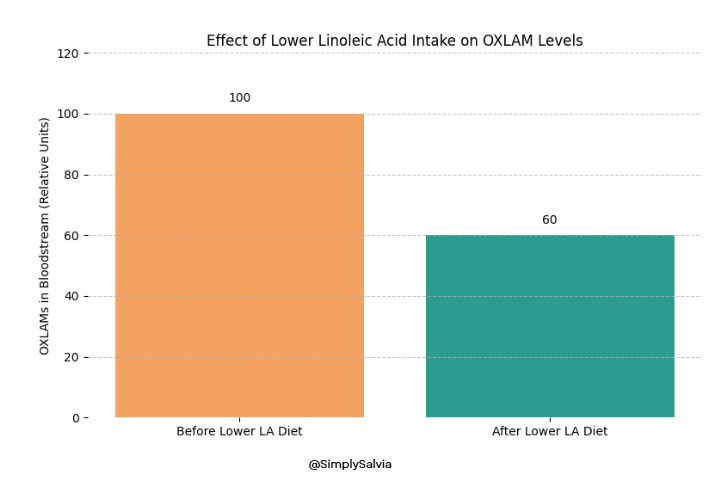
This study did not examine disease outcomes, but it provided a clear mechanistic link: dietary linoleic acid intake directly influences levels of oxidized lipid metabolites in humans. Whether these metabolites cause harm in real-world settings remains an open question but the pathway itself is biologically plausible and measurable.
Heating Oils Changes What We Inhale Not Just What We Eat
A more recent study shifted focus from diet to cooking chemistry, examining how different oils behave when heated. Researchers analyzed how aldehydes, reactive breakdown products formed during oil oxidation are generated and released into the air during high-temperature cooking.
The study showed that oil composition strongly determines oxidation behavior. Oils richer in polyunsaturated fatty acids, including linoleic acid, were more prone to radical-driven autoxidation during heating, producing higher levels of aldehydes compared with oils lower in polyunsaturates or higher in antioxidants.
This research didn’t measure health outcomes directly, but it added an important dimension to the conversation: high-heat cooking with certain oils affects both the food and the surrounding air. The findings are especially relevant for frequent frying or poorly ventilated cooking environments, where exposure to oxidation products may be higher.
Detailed Readings
Lowering dietary linoleic acid reduces bioactive oxidized linoleic acid metabolites in humans
Exposure to Cooking Oil Fumes and Oxidative Damages