


Convenience, stress, nutrition — these shape health week by week. But some patterns are older, deeper, written into our chromosomes and hormones long before groceries or lifestyle even enter the scene. Autoimmune disease is one of them. Women make up nearly 80% of patients across many autoimmune conditions, and until recently the explanation lived mostly in vague phrases like “hormones” or “immune differences.”
This week’s four studies peel back the layers, showing that female-biased autoimmunity is not one mechanism but a stack of biological realities; genomic, hormonal, and developmental working together across a lifetime.
Caught My Eye…
Women Shoulders Most of the Autoimmune Diseases
A massive UK population study following 22 million adults from 2000–2019 showed a steady rise in autoimmune disease across the country and a striking, consistent pattern: women carried a substantially higher burden for most autoimmune conditions. Diseases like lupus, Hashimoto’s, RA, Sjögren’s, and multiple sclerosis all appeared more frequently in women, and incidence climbed over time for both sexes.
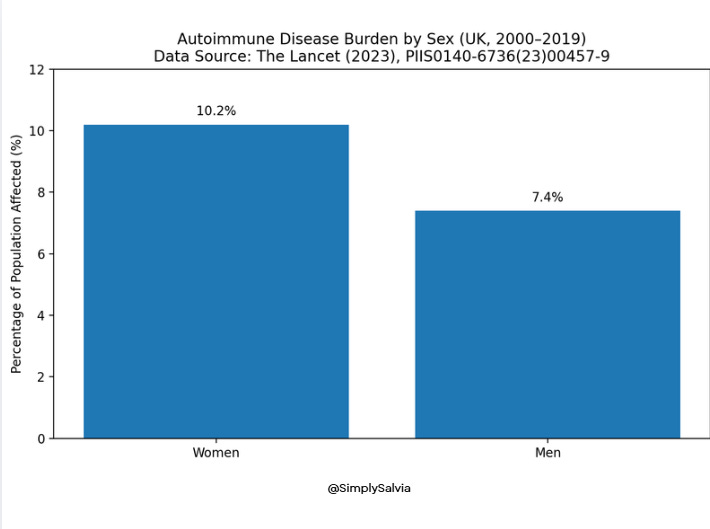
The scale of this dataset removes ambiguity. Female excess in autoimmunity isn’t anecdote or bias in diagnosis, it’s a robust epidemiological signal that demands biological explanation.
X-Chromosome Dosage & Immune Overactivation
One of the strongest lines of evidence behind female biased autoimmunity comes from X-linked immune genes, especially TLR7, a pattern-recognition receptor tightly tied to lupus biology.
Human single-cell studies show that TLR7 “escapes” X-inactivation in many female immune cells meaning women often express double the dosage compared to men. That matters because TLR7 amplifies type I interferon, the inflammatory pathway at the center of lupus and related diseases.
Then comes the clincher: real-world clinical data reveal that individuals with extra X chromosomes (XXY Klinefelter males or XXX females) have dramatically higher rates of lupus and Sjögren’s. In contrast, people with only one X (Turner syndrome) have lower autoimmune risk.
This is one of the cleanest gene–dose relationships in human autoimmune biology: More X-linked immune gene activity → more immune activation → higher autoimmune risk.
Xist RNA: A Female-Specific Autoimmune Trigger?
A groundbreaking 2024 Cell study pushed the field forward by asking a radical question:
What happens if you introduce the female X-inactivation machinery into a male immune system?
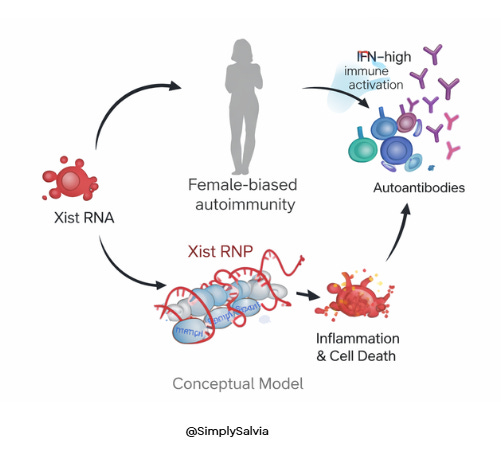
Researchers expressed Xist, a female-specific long noncoding RNA, in male mouse immune cells. The result:
Immune architecture shifted toward a female-like, interferon-high profile
Animals developed autoantibodies and inflammatory signatures resembling human lupus
Patients with autoimmune diseases were found to carry autoantibodies targeting Xist-associated RNP complexes
This suggests that components of the female X-inactivation system, unique to XX biology may directly participate in autoimmune misfiring.
A mechanism women have simply by virtue of having two X chromosomes.
Pregnancy, Hormones & Lifelong Immune Memory
Two separate bodies of work tie hormonal and reproductive biology to immune behavior in ways that can tilt risk toward autoimmunity:
Sex hormones: reviews show that estrogens (depending on dose and timing) tend to:
Amplify B-cell activity
Boost antibody production
Raise type I interferon responses
Androgens often move in the opposite direction dampening immune activity, providing a hormonal explanation for female-biased diseases like lupus and Sjögren’s.
Microchimerism from pregnancy: during pregnancy, fetal and maternal cells exchange and can persist for decades.
These microchimeric cells may:
Integrate into maternal tissues
Trigger immune surveillance
Influence later autoimmune risk
It doesn’t cause disease alone, but it adds one more layer to the female immune landscape. A second genome mingling quietly within the mother’s immune system long after childbirth.
Detailed Readings
TLR7 escapes X chromosome inactivation in immune cells
Xist ribonucleoproteins promote female sex-biased autoimmunity
Sexual Dimorphism in Innate Immunity: The Role of Sex Hormones and Epigenetics
Deciphering the Role of Maternal Microchimerism in Offspring Autoimmunity